Tuesday, February 17, 2015

Jason Voorhees for Survival Horror Games (OSR)

Jason Voorhees
Probably the most iconic slasher figure of the survival horror genre.
Here's his story.

Jason Voorhees (Human)
This is Jason from Friday the 13th Part II, III, and IV. He is still a living being. He is a  major threat to PC's but hasn't become the undead powerhouse he will be later in the series.

Armor Class: 12
HD: 6
Hit pts: 42
Attacks:  +8 melee, +6 ranged
Save: 11
Move: 120' (40')

Str 17 +2, Con 16 +2, Int 13+1, Chs 3 -3

Abilities:

  • Maniacal Fury (2 melee attacks per round) 
  • Maniacal Rage (all melee and unarmed damage is one dice higher)
  • Panic (Victims must make Saving Throw when encountering Jason or all attacks against Jason are at a -2 to hit. Most will flee for their lives. This is in effect until the victims elude Jason or believe they have given him the slip. Check for each new encounter with Jason. If they make three Saves in a row they are immune to this ability until the Sequel, if they survive.)
  • Stealth (Jason has the nasty ability to get the drop on his victims. He surprises them on a 1-4 on a 1d6.)
  • Tough (+2 AC, -2 Saves)


Weapons (In Jason's Hands)
Unarmed (1d3+2)
Garrote (1d4+2)
Knife, Hammer, etc.  (1d6+2)
Machete (1d8+2)
Wood Axe (1d10+2)


Jason Voorhees (Undead)
Accidentally resurrected by Tommy Jarvis in Part VI: Jason Lives, Jason is now an undead mass murder machine. He is difficult to stop, has incredible strength, and has gained a few new abilities from his undead state.

Armor Class: 14
HD: 8
Hit pts: 60
Attacks:  +10 melee, +8 ranged
Save: 9
Move: 120' (40')

Str 17 +2, Con 18 +3, Int 13+1, Chs 3 -3

Abilities:

  • Inhuman Strength (As an undead killing machine Jason is much stronger than he was as a living being. To reflect this he gains a +2 to all  melee and unarmed damage rolls, as well as to attempts to open doors. The +2 is also used as a bonus to any Strength attribute checks. This is in addition to his +2 bonus for his 17 Str)
  • Maniacal Fury (2 melee attacks per round) 
  • Maniacal Rage (all melee and unarmed damage is one dice higher)
  • Panic (Victims must make Saving Throw when encountering Jason or all attacks against Jason are at a -2 to hit. Most will flee for their lives. This is in effect until the victims elude Jason or believe they have given him the slip. Check for each new encounter with Jason. If they make three Saves in a row they are immune to this ability until the Sequel, if they survive.)
  • Rapid Healing (When using the Panic ability: if the victim fails their Saving Throw Jason will gain 3 Hit points per round as he stalks them. This ends when he kills them or they elude him. This, and an apparent sadistic streak, is why he often leaves victims and body parts for others to find: to panic and heighten the fear. If he is knocked to zero or lower Hp's and the victims are standing around checking the body out he still keeps healing and is likely to fake being 'dead' to suddenly spring to action and heighten their terror or attack them. He doesn't stop healing until the Panic ends; they must elude him.)
  • Stealth (Jason has the nasty ability to get the drop on his victims. He surprises them on a 1-4 on a 1d6.)
  • Teleport (Death has given Jason the ability to teleport to with 5 feet of a victim. He can use this ability up to 4 times per day. To use this he most be unobserved. If anyone is aware of his presence and can see him he cannot use this ability.)
  • Tough (+2 AC, -2 Saves)
  • Undead (Does not eat, drink, sleep or breathe. +2 to AC due to nonvital organs. Immune to Sleep and Charm spells.)


Vulnerabilities
Jason is tied to the waters of Camp Crystal Lake. If he is bound to the lake (chained to the bottom, trapped in a cage and sunk, etc) he will go dormant until reawakened at a later time.
He has been shown to be awakened by massive jolts of electricity, psychic summoning, etc.

Completely blowing his body apart has been shown to work, but he seems to always return for a Sequel.

Weapons (In Jason's Hands)
Unarmed (1d3+4)
Garrote (1d4+4)
Knife, Hammer, etc.  (1d6+4)
Machete (1d8+4)


70's, 80's and 90's Survival Horror (dying a horrible death with quick characters. OSR)


What is this?
This is an emulation of 70's, 80's and 90's classic horror films. The Thing, Friday the Thirteenth, Dawn of the Dead, Nightmare on Elm Street, The Nightstalker, Halloween etc etc. Survival horror films where most, if not all of the cast, is going to very likely die horrible deaths. These are almost always ordinary people trying to survive, not by spells or fantastic fantasy abilities, but surviving with cooperation and clever plans. It's a challenge and it can be a real blast to play.

To make it even more fun we needs a quick build PC for these games. Got split with an axe? NO problem. Take two minutes, make a character, and get back into that meat grinder! The PC's are easy enough to play two or three with minimal book-keeping. Split up the party. Enjoy.

Why use OSR based rules?
I like them. I've used D6, BRP, and other skills based systems for this type of game but I want to be able to run this in a game system familiar (ingrained?) with a large base of players. Yep, surprise on a 1-2 on a 1d6. Go it. Hit points and levels/Hit Dice. Yessir, know it. Str and Dex bonus to melee and to ranged attacks. Yup.
Basic and familiar. Christ most of us probably don't even need a base book for most of this.

Using the familiar systems I also want character creation to be fast. Damn fast. Easy but comprehensive stats for customizable characters. I want you to be able to build archetypes found within the horror movie genre, combat and non-combat, with little trouble.

There is also the options of  add-on rules such as sanity, driving, or other extras I've come up with to expand the game if necessary. It all depends on the level of complication desired. But at the heart of it all is the idea of easy fast characters getting chased around and slaughtered by a maniac and his best friend power tool.

Here's how we make the characters a very quick build. 

  • Roll attributes (Str, Dex, etc) normally or choose them any other way the DM wants.
  • The DM will decide what level you start at based on how competent he wants the characters and the tone of the game. (RJ MacReady from the Thing was higher level than the kids from the Friday the 13th films.)
  • Roll hit points (1d6 +Con bonus), figure out beginning AC (10+dex bonus), Saving Throw, and to Hit bonus. All standard stuff.
  • Figure out what abilities/stills you want your PC to have and fit it in with the quick Ability/Skill system below.
  • You have 4 points to build at first level; every level after you receive 2 more. 
  • Abilities are familiar: AC bonuses, Hit bonuses, Alertness ability, etc. You can buy them up at certain levels. Again pretty standard stuff. There's even a Hit Points ability to give you an extra 1d6 Hit points at even levels. 
  • Skills are a bonus (bonuses) you add onto a basic Attribute check when attempting something the DM calls for.  Limit of +5. 
  • Give them a name and a basic personality trait, receive equipment from the DM, and go!
  • There is no experience. If you survive for a sequel the DM can (and probably should) level you up for a sequel. 

SURVIVAL HORROR PC'S
HD: 1d6 per level. 
There is no experience. The DM decides at what level the PC's start at. If they surive (good luck) and there is a sequel the DM may raise the PC's one level.  
HP Limit: 5 HD. Characters can continue to go up in level gaining hit bonuses, better Saving Throw, Ability/Skill points, etc but gains no more hit points unless the Hit Points Ability is taken.
Save Throw: 15 at first level, drop one per level, minimum of 5.
Hit Bonus: +1 at 1, 3, 5,7,9
Ability/Skill Points: 4 at 1st level, 2 each level after.

Attribute Score/Skill Checks: 
Using common sense is the first rule. If there is absolutely no chance of success don't bother to roll. 

If there is a chance of success make an Attribute score check (Str, Dex, Con, etc). This is modified by points put into skills and a difficulty modifier. Each point put into the skill adds a +1 bonus to the Attribute score check. Skills can have a maximum of +5 bonus.

The DM may also use the skill bonuses for appropriate Saving Throws. 

Modifier to Ability Roll
Stupid Easy: No Roll
Easy: +8
Average: +4
Difficult: Base Ability Score Roll
Very Difficult: -4
Stupid Difficult: -8
Good Luck: -15

Abilities: 
All  Abilities except Alertness can be taken more than once. Each time you an ability costs the base skill point(s) listed in parenthesis after the name of the ability. The levels at which they can taken again and the effect of spending more points on them are noted in the base descriptions below.

AC Bonus (1 point) Levels 1,3,6,9.
Alertness (1 point) Surprised on 1 on 1d6.
Backstab* (1 point) +4 to hit at 1st level. 
⦁ Taken at level 5: x3 dmg. 
⦁ Taken at level 10: x4 dmg.
Hear Noise (1 point) Must concentrate to use. 1-2 on 1d6. 
⦁ Taken at level 3: 1-3
⦁ Taken at level 6: 1-4
⦁ Taken at level 9: 1-5
Hit Bonus (2 points):  +1 to hit. Levels 2,4,6,8,10.
Hit Points (2 points): Gain 1d6 hit points. Levels 3,6,9.

Skill Points: 
Adds bonus to Attribute score check.
Maximum of +5 bonus. 

Strength
Climb
Jump 
Swim

Dexterity
Boat 
If it's on water, use this
.
Drive
If it's on land, use this.

Security
Picking locks, bypassing electronics, etc. Getting in where you don't belong.

Sleight 
Picking pockets, palming small objects, etc. 

Sneak
Moving silently, hiding, etc. 

Constitution
Stamina
Extended activity such as long distance running, swimming, trying to stay awake, etc.

Intelligence
Computers
Programming, hacking, etc.

Fly 
If it flies, use this.

Medic
Diagnosis and treatment. To bind wounds the Character must make an Intelligence check with this bonus included. Success stops hp loss after zero and, if used above zero hp, adds back 1d4 hp after any combat has ended.

Occult Lore
Folklore of magic, vampires, ghosts, etc.

Psychology
Reading someone's mental state. May allow detection of lies, psychopatic tendencies, etc. 

Repair
Fixing physical objects. Includes carpentry, mechanics, etc.

Research
Finding information from libraries, archives, newspaper morgues, online, and other files.  

Science
Anatomy, Biology, Chemistry, etc. 

Survival
Finding water, shelter, food; making fire, etc in the wilderness.

Track
Following footprints, broken branches, etc. 

Charisma
Intimidate
Using forceful presence to get what you want. If the DM decides that the character is horrifically ugly, scary etc he may give a large bonus to this to compensate for a low Charisma score. 

Persuade
Manipulating someone to see your point of view or calm down. 
Includes bribing, appealing to logic or good nature, etc. 

The skill list is a most basic list. 
If you don't want generic skills and want to add specific skills for characters simply make one up. 

Here's a few examples of Science expanded for more specific skills:
Anthropology
Archaeology
Biology
Chemistry
Engineering
Geology
History
Physics


Thursday, February 5, 2015

Jeepers Creepers: The Creeper (Eternal Hunger for OSR Gaming)


The villain of two excellent horror movie is an ancient creature with unclear origins; it could be an ancient demon, a mutated sorcerer, or perhaps a victim of a curse. A psychic once gained insight on the Creeper; it can only live for 23 days every 23 years in the Springtime. During this 23 day rampage it feeds, gorging itself on the flesh and bone and blood of man. Then it curls up into a withered husk for another 23 years.

It is built for killing: massive strength, incredibly fast wings, talon hands and feet, and needled teeth.  It can easily rip a man apart.

The Creeper is a clever opponent, often much smarter than his prey. He is a brilliant hunter. He wears clothing, hats and long coats to help disguise his true nature. He can drive. He sets up lairs, listens to old music, makes traps and weapons, and decorates with artwork made from corpses and body parts. Although he does not speak he is not a dumb brute. There is method to his mayhem.

The Creeper possesses a wicked sense of humor. He will use corpses, body parts, and other means to scare his victims and amuse himself. He drove an old truck with a license plate that reads BEATNGU, which is first mis-interpreted as "beating you." The error is corrected later as the heroes realize it says "be eating you".


In the first movie the Creeper and his victims destinies revolve around various recordings of the tune "Jeepers Creepers."

It is unknown if the Creeper can truly be destroyed. Even in it's mummy-like hibernation state it may be difficult to destroy. Fire, acid, perhaps none of these will truly eradicate the Creeper. I would hazard a guess that if any part is left intact the Creeper will be able to regenerate itself somehow when the 23 year cycle begins again. Perhaps it is a spirit that inhabits a corpse, transforming it into the Creeper's form. Who can truly tell as so little information about the thing is known. Perhaps it can even be awakened early by spell or science. The opportunities for DM's are rich.
The Creeper
No. Enc.:  Unique
Alignment: Chaotic
Movement: 120' (40')/ 240' (80') Flight
Armor Class: 14 (Tough Hide)
HD: 8
Hit pts: 48
Attacks:  2 claws and a bite (1d6 each) or by weapon (see below)
Save: F8
Morale: 10
Hoard Class: XX
XP:  3100

Darkvision
The Creeper can see in the blackest pits as if it were daylight.

Massive Strength
The Creeper is strong enough that melee and thrown weaponry does damage at one dice step higher. He can punch through wood, cinder block, and tear apart light steel bare-handed. He can easily subdue a human and fly away with them by grabbing them with his taloned feet. He has been shown to lift up the rear of and drag a large truck while attached to it via harpoon and cable. He can jump a distance of 30' easily.

Prey Scent
Not everyone is compatible with the Creeper for regeneration. There is a 1-2/1d6 chance that a person has usable body part for regeneration.

To find his proper prey the Creeper possesses a third nostril on the bridge of his nose which allows him to locate viable prey. This nostril can only detect proper donors when the person is in a state of fear. Most are afraid by his mere presence and the situation they are caught in. They are at -2 to all actions until  the Creeper departs.

Those victims who try to be brave can be intimidated by a display from the Creeper.
Those who see the Creeper's display must Save (Paralyzation) at -4 or be afraid with the -2 penalty as above. A new Fear roll must be made each time the Creeper attempts to scare victims, although the second and subsequent attempts have no penalty to the Saving Throw.
Regeneration
Each time the Creeper is hit make sure to track how much damage each hit does individually as the Creeper regenerates by replacing damaged body parts with fresh ones gained from victims. If the players make a called shot (-4) to his wing he will be able to fly only at half speed. If both are damaged he can no longer fly until the wings are healed. If a leg is hit his land movement is halved. If both are hit he can only move by crawling or throwing himself along the ground 10' per round with his massive strength. DM's will need to use their judgement here. Roll with it.

To regenerate damage the victim's donor part is removed and swallowed whole; the damaged Creeper part is then usually ripped off, allowing the new part to move into position and regenerate all hit points lost on that wound as the new part takes on the features of the Creeper's lost body part. Lost movement will be partially or fully restored based on what was damaged and what was healed. This process takes 1d6 rounds + 1 round for each wound healed. He may have to do this a few times if there are not enough available body parts to swallow.

While regenerating the Creeper is vulnerable. His enemies gain a +4 bonus to attack him and he can only defend not attack. He often holes up to regenerate for his own safety, only healing out in the open as a last ditch effort to save himself.

When the Creeper is dropped to 0 to -9 hit points he is massively damaged and passes out for 1d6 minutes before reawakening and continuing his pursuit of prey. At this point he is so damaged he can no longer fly and can only move at a rate of 60' (30').

When dropped to -10 or lower he curls up into a mummified state. His 23 day rampage is done and he must await another 23 years to feed.

Spider Climb
The Creeper can scuttle up walls and hang from ceilings. He is shown standing on a speeding cop car, feet locked in place, keeping him from being swept off of the car.

Stealth
The Creeper is a master of stealth, especially at night. After dark his chance to surprise foes increases to a 1-4 on a 1d6. It will often do this to abduct potential body part donors or kill those in his way with a backstab (x2 dmg.)


Weapons 
The Creeper utilizes weapons and can even make them from the corpses of his victims; bones, flesh, and melted down fillings: shuriken (1d3/1d4 for the Creeper), knife (1d4/1d6 for the Creeper), and short spear (1d6/1d8 for the Creeper).

He has also been seen to use a battle-axe (1d8/1d10 for the Creeper). It could have others at its disposal.

He has also possessed a magic dagger (+2) which was somehow bound to him and tries to return to the Creeper by some sort of magical magnetic attraction; flying through the air and embedding itself into objects between it and the Creeper. It was used as the tip of a home-made harpoon and fired at the Creeper with a homemade harpoon gun,


Wednesday, February 4, 2015

Spaghetti Westerns: Unusual Weapons (OSR)

In the Spaghetti Westerns the hero or villain often has an unusual or signature weapon at his disposal. The Sartana and Sabata films were especially noted for this. Don't worry if it's a couple of decades ahead of 'current' western tech, just roll with it and have fun. Here's a few examples for bad guys or even players to spice things up.

Mauser C96
Cost: $50
Seen only at the end of the century, the Mauser semi-auto pistol holds a crazy amount of bullets for the time and includes a detachable wooden stock which can serve as a holster.

7.63x25mm Mauser
Dmg:1d8/2d6+1, Range:30', Ammo: 10-20
Note: attachable stock increases Range to 50'.

9x19mm Parabellum
Dmg:1d6/2d6, Range:25', Ammo: 10-20
Note: attachable stock increases Range to 50'.


LeMat Revolver
Cost (.36): $35
Cost (.42 and .44): $40
The LeMat is a single-action 9 shot cap and ball revolver with the notable feature of having a secondary barrel beneath the primary barrel which fired a single 16 gauge buckshot shell. The LeMat saw service with the Confederate States in the Civil War. Production of the pistol ended after the war. It was produced early on in .36, .42, and .44 caliber, the later being very late in the war. Each version came with the under slung shotgun barrel.
.36, Dmg: 1d6/2d6, Range: 25’, Ammo: 9
.42, Dmg: 1d8/2d6+1, Range: 30’, Ammo: 9
.44, Dmg: 1d10/2d6+2, Range: 30’, Ammo: 9
16 ga Shot shell,
Traditional Dmg:  2d6/1d6/1d6/1d4/1d4, Range: 10’, Ammo: 1, +2 hit first range increment with buckshot
Spaghetti  Dmg:  3d6/2d6/2d6/1d6/1d6, Range: 10’, Ammo: 1, +2 hit first range increment with buckshot


“Mare’s Leg” Carbine 
Cost: $40
A Mare’s Leg is the nickname for a repeating carbine, usually chambered in .44-40, with its barrel cut down to nine to 12 inches and the butt-stock cut down to make the carbine more pistol-like and usable with one hand. The cocking lever is often an enlarged loop. The length of the Mare’s leg imposes a –1 to Fast Draw. However, Mare’s Leg is most often worn in a custom holster, composed of straps and a large metal clip for the guns body, which functions as a Fast Draw holster (+1 Fast Draw), to offset the penalty for weapon length.
Dmg: 1d10/2d6+2, Range: 30’, Ammo: 6


Sabata’s Derringer 
Cost: $60
The custom derringer has four barrels in a circular formation, chambered in a .45 caliber, and a very large handle. This is because three smaller barrels are hidden in the handle. The end flips down and the three barrels are exposed, set in a vertical line. These barrels fire a smaller navy round. This tactic is often used to gain surprise when opponents think the shooter has fired all four of his shots.
Four barrels, Dmg: 1d8/2d6+1, Range: 20’, Ammo: 4
Three hidden barrels, Dmg: 1d6/2d6-1, Range: 5’, Ammo: 3


4-barrel shotgun 
Cost: $100
Two barrels stacked on top of two more barrels, this rare and expensive shotgun is a fearsome weapon, doubling the firepower of a shotgun. Two barrels can be fired then the other two can be rotated to be fired for the next round with no penalty.


Explosive Cigars
Cost: $2 per stick
A nasty little trick, these are essentially small sticks of dynamite hidden inside of a large cigar. The tip is lit and the short fuse is as well. Good for throwing or getting to an enemy to blow his own face off.
Dmg: 1d6, 5' Blast Zone (Save for ½ dmg), +1d6 dmg /1’ radius per cigar.
Damage is not open-ended.. Throwing Increment: 10’.


Sartana’s 5-shot Derringer 
Cost: $40
The weapon most identified with the mysterious gunfighter Sartana is his four-barreled derringer. But it has a secret, it is actually a small 5-shot revolver with the cylinder hidden inside the gun. Three of the four barrels are fakes. Anyone who thinks the shooter has fired all four of his shots is in for a big surprise when the fifth shot is fired.
Dmg: 1d6/2d6-1, Range: 20’, Ammo: 5


Sartana’s Weighted Watch 
Cost: $20
A dull gray and very large pocket watch on a long chain. It is actually made of lead and is useable as a flail and can wrap around objects with the chain, allowing the user to grapple the object or pull it towards the watch-wielder.
Dmg: 1d4, Range: 10’

Sartana’s Razor Throwing Cards
Cost: $20
Razor sharp, card sized and shaped bits of metal which can be thrown as a weapon. They are painted to look like playing cards and will only be seen for what they are by a close inspection. They come in packs of five.
Dmg: 1d3, Range: 10’


Sartana’s Pipe-organ of Death
Cost: $10,000. Total guess. The DM will probably set it higher, or at least make the PC's go on an epic adventure to find the device.

Ammo Cost: $500 for a full load of mini-cannon shells. $50 for a full load of machine gun rounds. It is unclear who made this fantastic machine, much ahead of its time in firepower. Sartana has shown an aptitude for building strange, complex, mechanical devices, so it is not inconceivable that with enough time and money, he could have designed this beautiful death machine.

One of the craziest and most entertaining weapons in the history of Spaghetti Westerns is the pipe-organ owned by Sartana in the film Light the fuse, Sartana is coming!

Beneath the outer wood panels are steel plates giving Sartana cover (-6) while he manipulates the buttons, keys, and pedals of the death machine.

The outermost tall pipes, far left and far right, swivel forward to reveal they are actually multiple shot mini-cannons. Each cannon holds five rounds, which are automatically fed into the firing mechanism after the previous shot. The cannons can each be fired twice per round. The cannons can also be dropped sideways, at a 90 degree angle, to blast those who would come up on the side of the organ player.
Two cannons 3d6/5d6, 15’ Blast Zone, 2 shots each per round, Save for half damage.

The four center pipes drop down to reveal they are machinegun barrels, linked and firing on the same front firing arc. The guns are not precision weapons, and anything and anyone, friend or foe, in the firing arc must make a Save for half damage. Each gun holds enough ammo for 6 rounds of continuous fire.
Four machine-guns, cone-shaped area effect (5’ at beginning, 30’ wide, 100’ long), Dmg: 3d6/6d6, Save for half damage.


Tuesday, February 3, 2015

Scooby Doo .... F'taghn! (Savage Worlds Adventure)

An oldie but a goody.
Here's the pdf for my Scooby Doo .... F'taghn! adventure for Savage Worlds I wrote about five years ago.

UPDATE March 15, 2020.
Link fixed.

Pay for your coffins....Django and Sartana are coming! (OSR in the American West.)

Re-edited and re-posting from the old Blog.
We had a lot of fun with this one.

The game can be run one of two way: Traditional John Wayne, Randolph Scott westerns or the Clint Eastwood, Italian Spaghetti Westerns. Traditional is grounded in more 'realism' whereas the Spaghetti's are all about style and violence.

Rolling Attributes
Pick your favorite method.

Attribute Bonuses/Penalties
Either the standard Swords & Wizardry +1 or Labyrinth Lord’s +1 to +3.
For Traditional: I prefer the S&W method.
For Spaghetti's: I prefer the latter as it gives a wider range to class special abilities and to Fast Draw.

Armor Class
Normal Armor class, and modifiers are used.
Firearms ignore the first four points of personal armor. For example: Plate –6 [+6] would only give protection of –2 [+2].

Starting Money
Characters begin with 3d6 x $20 as first level characters. Characters starting off at higher levels receive an amount of beginning money equal to 3d6 + the characters level x $40 or whatever their DM feels is appropriate to the game.

CHARACTER CLASS
Cowboy
Gambler
Gunslinger
Lawman
Scout
Soldier

Experience, Saving Throw, To Hit 
Each class uses the Fighting Man experience table, Saving throw, and receives a +1 to hit at each level.

Level Limit
There are none beyond the standard 20th level. However, in Traditional westerns even the best heroes are rarely beyond level 10 or 12 in skill. Higher levels than this should be ultra-rare, perhaps the best in the West.

Hit Points
Traditional: HD limit of 5th level. Skills increase past this but HP's are locked at fifth.
Spaghetti: Roll for them at each level as per normal rules. Spaghetti heroes take massive amounts of punishment before giving up the ghost.

Multi-Class
The classes are constructed for the characters to easily multi-class between levels if they desire. As an option, the DM may want to limit multi-classing by only allowing the character to take a new class if they have an ability score bonus in the Prime Attribute of the new class. Abilities do not stack.

Cowboy (Cowpoke, Gaucho, Cavalry, etc.)
Hit Die Type 1d6+2, After reaching 10 hit dice, the Cowboy gains only 2 hit point per level
Prime Attribute (5% xp bonus) Con 13+
Marksman
Being proficient with firearms is a necessity on the trail. With snakes, coyotes, bandits, and hostile Indians you have to learn to defend yourself.
The Cowboy receives a +1 to hit with all firearms.

A Dexterity check to guide his animal. This includes situations such as staying mounted while the horse is bucking or upset, calming and controlling the horse, guide it with his knees so the rider can shoot or rope, etc.
The Cowboy gets to add a +1 bonus to Riding Dexterity checks at first level and at later levels.
Traditional: 3, 6, 9, and 12 
Spaghetti: 5, 10, 15, and 20 

In addition, the Cowboy can do the following:
Use his Dex bonus to increase his mount's AC.
With a successful check, the Cowboy can drop along the side of the horse for cover, gaining a +4 cover bonus to his AC.

With a successful check the Cowboy can fall from a horse and take half damage (see Riding in Rules Clarifications: Miscellaneous.)

With a successful check the Cowboy can coax the horse to leap obstacles and the Cowboy
can hang on while the animal is performing the maneuver.


Roping
The Cowboy receives a +2 bonus with the lariat (ranged attack).

Gambler (Gambler, Con-Man, Thief, etc.)
Hit Die Type 1d6, After reaching 10 hit dice, the Gambler gains only 1 hit point per level
Prime Attribute (5% xp bonus) Int 13+

Backstab
When attacking with surprise, from behind, the Gambler gains +4 to hit and inflicts double damage. At levels 5-8, damage is tripled, and from a Gambler above level 8 such an attack inflicts quadruple damage.

Fast Talk
With a bit of conversation, the Gambler is able to attempt to befriend, persuade, charm, or outright con an individual to his way of thinking. After 2d6 minutes of cajoling, flattering, drinking, etc. the victim of the Fast Talk must make a Saving Throw. This Saving Throw has a cumulative -1 penalty roll for the Gambler levels 1, 5, 10, 15, and 20.

Gambling
The Gambler is a cardsharp, making his living by the cards and his wits. At levels 1, 5, 10, 15, and 20 the Gambler gains a cumulative +1 bonus to his gambling checks.

Hear Noise
The Gambler has honed his hearing to eavesdrop to hopefully pick up juicy bits of information or to listen for disturbances while on a bit of thievery. His chance to hear noise is 3 in 6 at first level increasing to 4 in 6 at 3rd level, 5 in 6 at 7th level, and 6 in 6 at 11th level. To use this ability he must stop all activity and concentrate.

Open Locks
Gamblers are skilled at picking locks, opening safes, etc. Some are difficult and may require a penalty to the open roll.  The base chance for success is 10 + 1/2 level + Dex bonus on a d20. Superior tools may grant a small bonus just as inferior tools may incur a small penalty.

Pick Pocket
The Gambler is often called upon to manipulate small objects, such as a card, coin, derringer, or small knife in his line of work, as well as picking the occasional pocket. The base chance for success is 10 + 1/2 level + Dex bonus on a d20.

 If the Gambler fails his roll the victim has a 1-2 in 6 chance of detecting the manipulation, pick pocket attempt, etc. A Dex bonus will drop the chance to 1 in 6. See Gambling below.

 If the Gambler rolls a natural 20, he has been spotted by his victim or victims if he is picking a pocket, cheating, etc.

Gunslinger (Gunman, Bounty Hunter, etc)
Hit Die Type 1d6+2, After reaching 10 hit dice, the Gunslinger gains only 2 hit point per level
Prime Attribute (5% xp bonus) Dex 13+

Fast Draw
A Gunslinger gains a cumulative +1 bonus to initiative while wielding a firearm at first level and later levels.
3, 6, 9, and 12

The Gunslinger does not receive a -4 penalty to attack for drawing a weapon and attacking in the same round.
If group initiative is used, the Gunslinger still rolls for individual initiative.

For Example: A 6th level Gunslinger with a +2 Dex bonus wielding a Heavy Pistol (-1 initiative) with a fast draw barrel (+1 initiative) draws his firearm. He rolls the 1d6 for initiative and gets a 3. The penalty for drawing a weapon is -3. His total is : 3 rolled, -3 for drawing, +2 Dex bonus, -1 for Heavy pistol, +1 for the fast draw barrel equals an initiative total of 2 initiative.

Steely Gaze
At 1st level, the Gunslinger can intimidate a number of creatures with HD equal to his level. The creatures must be able to see the Gunslinger’s stare to be affected. The creatures are allowed a Saving Throw to avoid this effect. Those that fail suffer a –2 to all attacks on the Gunslinger. Most will flee; only the most determined will stay and fight.
This ability can be used 1 per day per Gunslinger level.

Extra Attacks
Receive an extra attack at levels 5 and 12.
The attacks can be a mix of both melee and ranged attacks (although pulling a ranged weapon and firing in the same round incurs a -4 penalty to all attacks taken after the ranged weapons is pulled.)

Off-hand penalties do not apply to the extra attacks, only the one off-hand attack from using a second weapon. The extra attacks are considered to be used with the primary hand,

Maneuvers such as fanning the hammer, fast firing double-action pistols with penalties, or auto-fire CAN be taken with the extra attacks. Each extra attack is at the same penalty as the maneuver attacks.

Lawman (Sheriff, Texas Ranger, Pinkerton, etc.)
Hit Die Type 1d6+2, After reaching 10 hit dice, the Lawman gains only 2 hit point per level
Prime Attribute (5% xp bonus) Cha 13+

Assess
The Lawman can use this ability to observe a person for a single round and then make a conclusion as to that persons age, character level, class, etc based on the experience and instinct. This comes in very handy when  dealing with outlaws and gunmen. Knowing when your out-gunned keeps a Lawman alive.

The base chance for success is 10+1/2 level+Wis Bonus on a 1d20.

Badge
The Lawman has an air of authority and can use it. He can arrest anyone who has committed a crime or who he suspects of committing a crime and hold them for trial. Once per day per level, he can attempt to use his authority to intimidate one person. If the target fails a Saving Throw any attacks against the Lawman are at a -2 penalty. Most NPC's are likely to give up and surrender.

Deputies
Starting at third level, the Lawman  can deputize and pay a posse. The number of deputies is limited to the characters Cha score plus half of his level, and it is recommended that most are first level characters. The posse will stay with the Lawman for a number of days equal to his Cha bonus. They will be loyal up to a point: nobody is going to stick for very long with a man who is making poor decisions and probably leading them to their death.

Knowledge
Through both informants and official channels, the Lawman is often in the know on important information, both locally and territorially. Such pertinent information may include who a mysterious gunman may be, who started a feud with who, or if the mysterious stranger who just rode in town is wanted. The base chance for success is 10+ 1/2 level + Int bonus on a d20.

Scout (Army Scout, Mountain Man, Tracker, etc.)
Hit Die Type 1d6+1, After reaching 10 hit dice, the Scout gains only 1 hit point per level
Prime Attribute (5% xp bonus) Dex 13+

Awareness
One of the most important abilities of the Scout is his sharp senses. The ability to detect danger is one of the key abilities of the Scout and can make the difference between life and death. Scouts can hear noise on a 1 or 2 on a d6.
They are also only surprised on a 1 on a 1d6.

Backstab
The Scout, once he has found his target, is adept at attacking from surprise to kill the prey.
+4 to attack. x2 damage. x3 damage at levels 5-8. x4 damage at 9th level and above.
This also includes ranged attacks until the target(s) are aware they are being fired upon.

Survival
The Scout’s ability to live off of the land and survive, this check is rolled in addition to normal foraging rolls. The DM may modify this check for plentiful or exceptionally harsh terrain. The Scout makes a check at 10+ 1/2 level + Int bonus.

Track
Scouts are also capable trackers, often employed as guides and hunters. The base chance for success is 10 + 1/2 level + Wis bonus. This roll can be modified by the DM for circumstances such as tracking across soft mud, tracking across snow, the quarry is trying to hide their tracks, etc.

Soldier (Military, Fighter, Brawler, etc.)
Hit Die Type 1d6+2, After reaching 10 hit dice, the Soldier gains only 2 hit points per level
Prime Attribute (5% xp bonus) Dex 13+

AC Bonus
Increased chance to to parry or dodge attacks, +1 AC

Brawler
Either through training or natural ability Soldier's know how to fight. They gain +1 to hit melee weapons and unarmed attacks.

Extra Attacks
Receive an extra attack at levels 5 and 12.
The attacks can be a mix of both melee and ranged attacks (although pulling a ranged weapon and firing in the same round incurs a -4 penalty to all attacks taken after the ranged weapons is pulled.)

Off-hand penalties do not apply to the extra attacks, only the one off-hand attack from using a second weapon. The extra attacks are considered to be used with the primary hand,

Maneuvers such as fanning the hammer, fast firing double-action pistols with penalties, or auto-fire CAN be taken with the extra attacks. Each extra attack is at the same penalty as the maneuver attacks.

WEAPONS AND RULES
The firearm categories have been kept as generic as possible. Unless the weapon is a gimmick, it does not matter what make or model it is. Only that it is a lethal weapon in the hands of the hero. For game purposes we are only concerned with initiative, rate of fire, range, damage, type of ammunition for reloading times, and how many bullets/charges the firearm holds.

Initiative
Normal combat initiative is 1d6 + Dex bonus.

Drawing a Weapon
A character can draw a weapon and use it in the same round but with a penalty of -3 to the initiative roll and a -4 to the attack roll. This can be further modified by equipment bonus or penalty and character ability such as the Gunfighter fast draw ability.

Example: A character has a +1 Dex bonus and is using a pocket pistol for an additional +1. He rolls a 5 on his initiative -3 for pulling a weapon in the same round +2 for bonuses for a total of 4 on initiative.

Equipment Modifiers for Drawing a Weapon (-3 to initiative)
Derringer or Pocket Pistol +1
Carbine, Sawed Shotgun, Coach Gun -1
Heavy Carbine, Rifles, Shotguns -2
Short Barrel +1, extra –1 to range penalties
Long Barrel -1, increase range increment by fifty percent
Flap/Army Holster -1
Swivel Rig +1, -1 to hit, must unhook to reload
Spring-sleeve Holster +1  

Rate of Fire
Anyone can make one attack per round with no penalty.

Fan the Hammer/Flick the Lever
Holding down on the trigger and fanning the hammer of a single-action revolver with your off hand or quickly flicking the lever and pulling the trigger of a lever-action carbine or rifle to fire rapidly.
3 attacks, -4 per attack.

Double Action Pistols
With a double-action pistol, the gunman cannot fan the hammer, but he can take two shots per round with a –2 per shot.

Gatling/Automatics
Early automatic weapons fire at a slower rate and are mounted on tripods, walls, or vehicles due to size. This is a necessity and gives no bonus to hit.

They can attack up to four times per round. Each attack uses five rounds of ammunition.
The sheer number of bullets fired adds a bonus dice to the weapons damage but as fire is sustained it becomes harder to control the weapon and penalties are applied. The trade-off of this is the opportunity for more attacks even at a penalty.

The bonus/penalties are taken as fired.  0 penalty to the first, -1 to the second, -2 to the third, -4 to the fourth. And you fired off twenty rounds to get there.

More than one opponent can be hit with a single auto-fire attack. Up to two more targets can be targeted as long as they are within 5' of the primary target. One attack roll is made and compared to the AC of each available target of the attack. Auto-fire damage is rolled for each target hit.

Aiming with Firearms
Take a round, gain a +2 bonus to one shot. This can be done for two straight rounds for a total bonus of +4.

Two Weapons
-2 primary hand, -4 off hand.

Range
Firearms have five range increments, and suffer the standard –2 penalty per increment after the first.

Damage
The damage for firearms depends on which type of Western you are running.
For Traditional use the standard multi-polyhedron dice for non-open ended damage.
For Spaghetti's the damage uses d6's and is open-ended: if you roll a six on the dice, roll it again and add the dice. Do this until you don’t get anymore sixes.
The damage listed before the backslash is for Traditional, damage after is for Spaghetti's.

Ammunition Type and Reloading
A cartridge weapon can be reloaded with three bullets per round. No other action except movement can be attempted while reloading. However, a shooter can, if desperate, reload one shell and attack with a –4 penalty for rushing the attack.

Cap and ball firearms require two rounds to load a single load, or one round to replace a cylinder. No other action except movement may be attempted when reloading. If you’re reloading pistol loads one at a time, you cannot move faster than a walk and still reload. Cylinders can be reloaded on the run,

Firearms which require a magazine (Gatling) take only one round to reload and ready. However a desperate shooter can hurry the reload and attack with a –2 penalty for rushing the attack.

Firearms Categories
Pistols
Most pistols of the mid-to-late 1800’s are single-action revolvers. Double-actions exist, but are not as common and are more costly, not replacing the single-action until the end of the century. Most pistols hold six bullets, although some rare models, such as the LeMat revolver, held up to 9 shots. Most of these non-six shooters suffered from delicate mechanical parts or odd caliber bullets which were difficult to find and purchase. Almost all revolvers during the Civil War are cap and ball, with the rare exception such as the LeMat and it’s hard to find ammo. Derringers were fairly common, multi-barreled small pocket pistols, easily hidden and often used as a means of last resort self defense.

Rifles
Rifles come in a large variety of forms and are chambered for large rifle rounds. Civil war rifles were almost universally cap and ball single shot rifles. Later, when metallic cartridges became widely available, many of the older single shot were modified to accept the new ammunition. Unlike the smaller cartridge repeating rifles below, those chambered for rifle cartridges held only six shots.

The first widely produced repeating rifles were the smaller cartridge 7 shot Spencer rifle and the 15 shot Henry. Before these came about, there was the rare cap and ball revolving rifle such as the 6 shot Colt Revolving Rifle, and the Spencer and Henry Rifles gave way to the more reliable 15 shot Winchester Rifles.

The Buffalo rifle is a powerful weapon, often used to bring down large game such as bear, elk, and most famously, buffalo. The most common such rifle is the Sharps big single shot .50. European models exist as large-bore elephant rifles (1 shot or 2 shot for double barrel models) used for safari to bring down big game such as rhino and elephant.

Carbines
Carbines are essentially shortened rifles, often chambered with pistol cartridges, and made for ease of use while in the saddle or on a wagon. During the Civil War, many were cap and ball models, with the occasional metallic cartridge carbine. Like rifles, carbines come in all types: single shot (1 shot Military Carbine), revolving cylinder (6 shot Colt Revolving Carbine), and lever action (7 shot Spencer Carbine, 12 shot Winchester).

Heavy carbines are carbines chambered with a larger cartridges, specifically lower-velocity rifle rounds. The larger rounds only allow for 6 bullets to be loaded in the repeating models.

Shotguns
Most common shotguns were 16 gauge. Models are single barrel, double barrel, or the very rare 5 shot revolving shotgun (Colt.) In the late 1880’s lever action shotguns were introduced (5 shot) and in the 1890’s pump, or slide-action, shotguns first appeared (5 shots).

Coach guns were shorter barrel versions of the shotgun, named so because of their use on guards riding “shotgun” on stagecoaches. They are much easier to use on horseback than a regular shotgun, and most shotguns in the hands of gunmen, outlaws, and lawmen will be these shorter models.

Sawed off shotguns have their barrels cut extremely short, often with most of the stock removed, to form a lethal pistol sized shotgun.

Gatling Gun
The most famous repeat-fire weapon of the west. Capable of throwing out a tremendous amount of bullets, it was hand-crank operated, had multiple rotating barrels which facilitated cooling and synchronized the load-fire process, and had a top fed 50 shot magazine. After 1871 a 400 shot ammo drum was available.
Expensive and deadly, it is rarely seen outside of the military.


MISCELLANEOUS
Binding Wounds
As this is inherently a no magic setting, it is recommended that this optional rule is used, allowing characters to regain 1d4 hit points  immediately after combats.

Gambling
1d6 + Int modifier, highest roll wins. Modifiers such as the Gamblers gambling ability apply.

Cheating
Dexterity check for a +1 bonus.
 A Gambler may substitute his Pick Pockets roll if he has a better chance.

 If the cheater fails his roll the victim has a 1-2 in 6 chance of detecting the manipulation, pick pocket attempt, etc. A Dex bonus will drop the chance to 1 in 6.

 If the cheater rolls a natural 20, he has been spotted by his victim or victims.

Riding
Dexterity check with modifiers as decided by the DM.
Falling off a moving horse or wagon does damage depending on the horses movement. For careful the damage is 1d4, for walking the damage is 1d6, and for running the damage is 2d6.

Roping
Normal ranged attack roll with a range of 30’. Once roped, the target can immediately make a Saving Throw at –4 to slip out of the lariat. If the victim fails, he or it is hooked on the cowboys line and can be dragged for 1d6 make a Str check (-4) vs. the cowboy’s Str to pull the rope out of the cowboy’s hands.

A called shot at –4 can be made to rope a leg, weapon, etc. The victim must make a penalized Str roll, as above, vs. the cowboy’s strength to retain a weapon, not have a leg pulled out from under him, etc.

Stampede!
If the character is caught in a stampede, he can either take cover or get stomped.
Sturdy cover such as a large boulder, tree, or a good thick wall will protect the character.
If no cover is available, the character can try to kill one of the stampeding animals and take cover behind its carcass. If this happens, the character automatically takes only half damage and can make a Saving Throw to take no damage at all.

If no cover is available the character takes 6d6 damage as he is stomped and gored by the panicked herd.


Thursday, January 29, 2015

Thing from Another World (Death in Many Forms for OSR)

Had this sitting around for a while. Decided to finish it. Hopefully it is coherent. It's been one of those days. :D
This thing is based off the 1982 John Carpenter film and it's prequel.
It is lethal. PCs should be very well prepared for this.


Thing from Another World
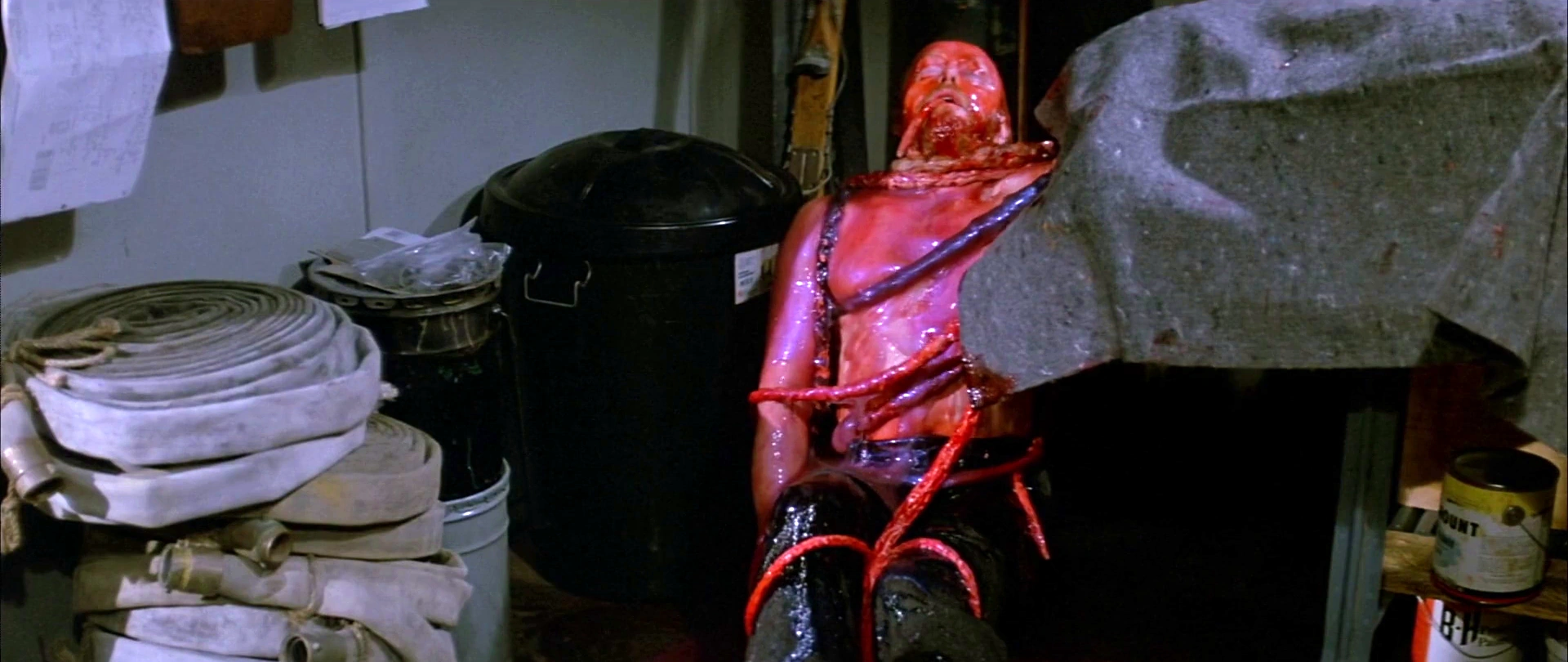
An extraterrestrial parasitic life form capable of assimilating organic organisms. It will perfectly mimic the dominate organic organism and then quietly attempt to assimilate the entire species.
They are an extinction level event waiting to happen. They must be destroyed when found.
AC: 12  (see Size below)
HD: 8 HD base used as a whole or split among it's body parts (see Split ability below)
HP: 48 base used as a whole or 8 per body part HD (see Split ability below)
ATTACKS: (see Size below)
SAVE: by hit dice split
SPECIAL: Absorb, Mimic, Split, Merge, Combat Abilities, Regeneration, Hibernation
MOVE: (see Combat: Movement below)
EXP: Variable

Assimilate
A Thing can perfectly mimic any organic organism. To do so it must assimilate the victim by pressing its flesh directly against the flesh of the victim. The invading flesh must be soft; teeth, hard projectiles, claws, etc cannot initiate the process. A Thing an do this by pressing itself against the target or wrapping tentacles around the target to envelope as much of the victim's flesh as possible. Larger than man-size Things might do this by brute force while a smaller one will most likely use stealth to join its flesh to its target.

Edit, Clarification: When assimilating the Thing has two options: it can absorb the victim and take his place or allow it to stay a separate entity; a new Thing.

A Thing must make an attack roll to hit flesh. If the target is naked, without shirt, etc it is a normal to hit roll. If their flesh is sufficiently covered the face is the almost always preferred target and they must make a called shot with a -6 penalty to hit. If the Thing surprises its victim it gains a +4 to its attack roll, dropping the penalty to -6 for the called shot. Once a Thing has made contact its flesh bonds with the victim's and it must be ripped or burned away causing 2d6 damage to the victim. To rip away the victim must make a Str roll with a -6 penalty. If others help rip the victim away the penalty drops by 2 for each person helping (maximum three helping.)

If a victim is forcefully separated from a Thing he must make a Saving Throw (Poison). If successful he has fought off the invading organism. If failed he will fall into a coma in 1d6 minutes as the assimilate continues from inside. He will be lost as the Thing continues to assimilate and replicate his flesh from the inside out. It will awaken after 1d6x5 minutes and attempt to pass itself of as the victim. Let the player play as normal, don't let him know what has happened. When the Thing emerges it will be as big a shock to them as anyone else.

If the freed victim is somehow flash frozen it may help stop the assimilate process until some sort of healing or medical process can be used to save him.

Each round the victim stays attached to a Thing the victim must make a Saving Throw (Poison) with a cumulative -2 penalty after the first round. Once the Save is failed the  victim is paralyzed as the Thing's flesh penetrates into the victim's circulatory and nervous systems . Within 1d6x5 minutes the internal assimilation and mimicry are  complete.

The target of assimilation must either be alive or freshly dead: a Thing will not assimilate decaying flesh. It cannot assimilate inorganic material: fillings, prosthesis, surgery pins, etc will be ejected from the mass.

A Thing will generally try to assimilate a victim quietly and in private. It does not want to be interrupted;it prefers stealth tactics to outright violence and it can't replace someone and infiltrate a group if the group knows a person was attacked. If interrupted during this assimilation time it will try to flee. It will have obvious flaws in it's physical form and can be easily identified.

Blatant assimilation is almost always a last ditch defense to save itself when it has no other choice. If it's hand is forced a Thing can merge with other Things (see Merge below) and outright try to destroy its enemies.

Mimicry
Once it has absorbed and replicated and organism a Thing can perfectly mimic that creature.
It activates with full 10HD and abilities. It also gains the replicated creatures natural weapons, movement, special abilities, spells, etc at the level of the creature absorbed. It is indistinguishable from the original creature to all but the most specific tests. It has all of it's memories, mannerisms, habits, etc. Even defects such as a weak heart, weak eyes, scars, etc are replicated.
It must acquire clothing and other equipment to complete its masquerade.

Split
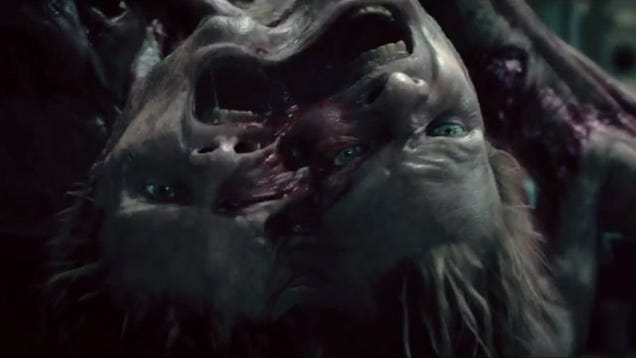
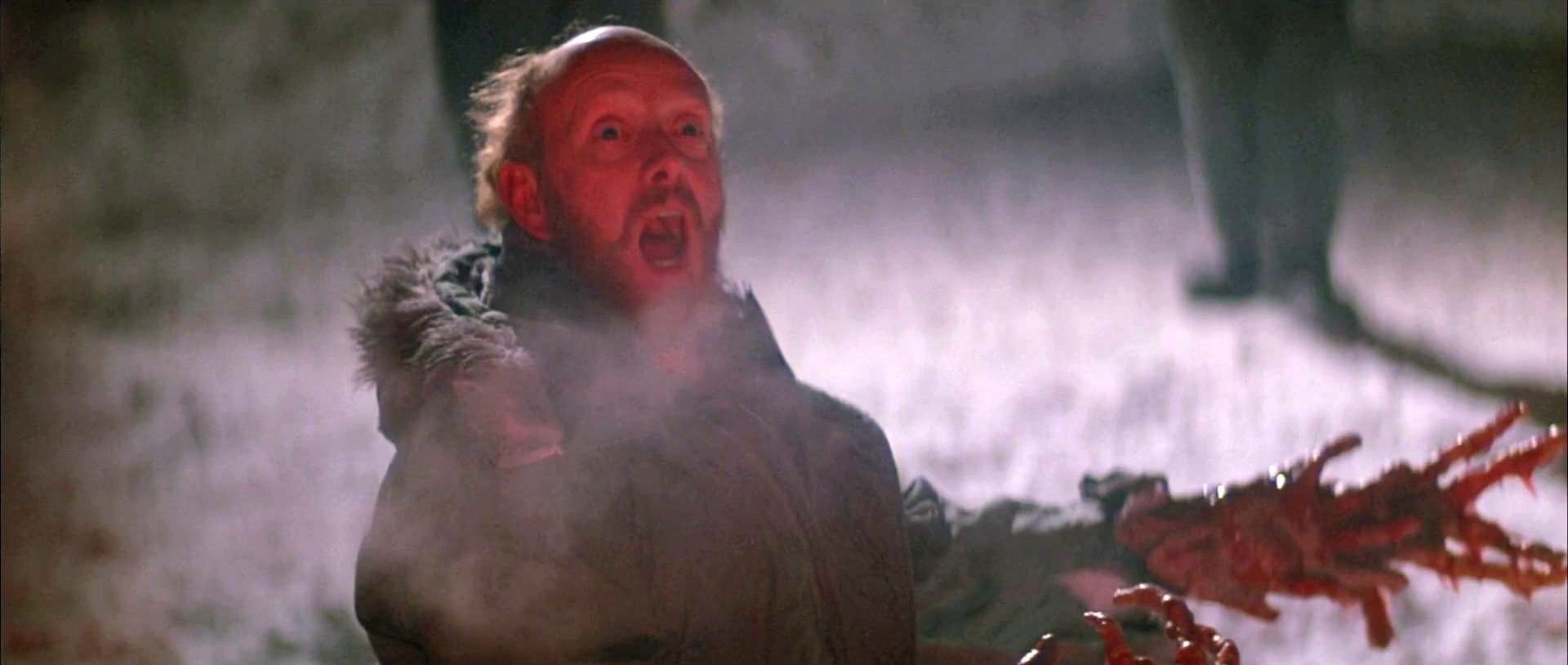
A Thing is a collective organism. Each of its cells can split apart as a separate entity working for the survival of the whole creature. This gives it the ability to split itself off into smaller creatures. This ability is used to save as much of the creature as possible as parts of the collective body become damaged beyond use (such as by fire) or to separate into smaller Things to stealthily hunt down and absorb a victim.


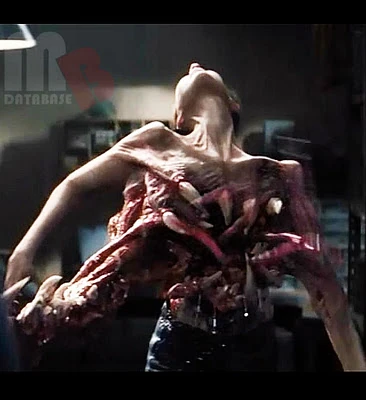
It's ability to split also gives it the ability to grow arms, legs, claws, tentacles, extra heads, eyes, whatever from it's separated body parts. It can split it's flesh to reveal vicious teeth. The combinations are only limited by what a Thing has absorbed in the past. (See Combat: Attacks and Damage below.) The sudden reveal can be a shock to see as the flesh splits and a vicious drooling maw comes a your face. If the Thing is under suspicion it still gets a surprise roll of 1 on a 1d6 to surprise by suddenly splitting open. If it is not under suspicion the chance for surprise goes up to 1-3 on a 1d6.

A Thing mimicking a human has 8 HD, divided into sections for convenience to track abilities, hit points, attack bonuses, saves, etc of smaller forms. When a Thing splits add together the Hit Dice of the new split forms.  For example if a head splits off it's a 1 HD creature. The rest of the creature is now 7HD. If the upper torso  separates from the pelvis and legs we now have three Things with the following HD: Head Thing - 1HD, Arms and Upper Torso Thing - 4HD, Pelvis and Legs Thing - 3HD.
Each is now a separate entity, an independent Thing seeking to attack and assimilate it's enemies.

If under direct attack or it decides to enter combat a efficiently as possible a Thing will most likely remain at an 8HD pool and use it's greater damage and hp potential to kill or absorb its enemies

Parts Hit Dice:
Head 1 HD (8hp)
Torso 3HD (24hp) [2HD upper torso(16hp) / 1HD (8hp) pelvis if body split apart]
2 Arms 1HD each (8hp each)
2 Legs 1HD each (8hp each)
If hands or feet drop off they are 1/2 HD (4hp) and the arm or let itself becomes 1/2 HD (4hp).

A Thing has maximum hit points per level. It has control over its cellular structure and is built to survive. Unless a called shot is made to an extremity, damage is taken by the torso. Once it is destroyed or in serious threat of permanent damage the Thing will kick into survival mode and it will split its body into smaller Things with 8hp per HD.

Any damage done to specific parts (such as legs on fire) those parts take the damage and it does not affect the other parts. If full body damage is done each part takes the entire damage rolled to its individual hps.

A Thing's intelligence seems to drop with it's smaller sizes. Smaller Things seem to rely more on instinct than on reasoning while larger Things, carrying the experiences of those it has assimilated can be frighteningly intelligent, using technology, even building escape vehicles.

Merge
If threatened with destruction multiple Things can join to increase their mass and fighting ability.
For each man-sized thing merged the base Thing (highest HD) gains 2 HD. The max HD for this is 16 HD. This increases, attacks, damage, and armor class (see combat below.)

Combat
Attacks and Damage
A Thing can split its body open to reveal hidden weaponry: teeth, claws, tentacles, barbs, etc. Nearly anything is possible as long as it was an organic natural weapon previously mimicked. While doing horrific damage these solid weapons cannot initiate an assimilation.
At twice man-size or larger (16HD) it make four attacks per round at 1d12 or one massive attack at 3d10.
At larger than man-size it can make up to three attacks per round at 1d10 or a single attack at 3d8
At man-size it can make up to two attacks per round at 1d8 a single attack at 3d6.
At half man-size (split in half vertically or horizontally) it can make two attacks at 1d6.
At small-size (head, arm, leg, etc.) it can make one attack at 1d4.

Special Attacks
If the DM wishes a Thing can have ranged and other attacks based on what it has assimilated.
One of the easiest ways to do this is simply steal special abilities from other monster stats. I would be careful with this though, only one or two, or it will be overwhelming.
Acid Spray (2d6 per round for 3 rounds). Range of 30'.
Web. As per the spell.
Melee attack at 10' extended range.
If two tentacles hit, draw the victim to the mouth for automatic damage each round until a Saving Throw (Death) at -4 is made.

Armor Class
A Thing takes minimum damage from piercing weapons. Blunt and slashing do half damage. Magical and Heavy Weapons (including explosives) do normal damage.
At twice man-size or larger (16HD)  it is AC 16 due to increased size and mass.
At larger than man-size it is AC 14 due to increased size and mass.
At man-size it is AC 12.
At half man-size it's AC 13 due to smaller mass to hit.
At small-size (head, arm, leg, etc.)  it is AC 14 due to smaller mass and increased speed.

Movement
While mimicking a creature a Thing uses that creature's natural movement rates until it reveals itself as a Thing.
If necessary it can take a full round action and grow wings, legs, or other ways of moving around quickly. Everything from extra human appendages to insect legs and tentacles based on what it has assimilated in the past.
At twice man-size or larger (16HD): movement drops back to 120(40) as the bulk begins to slow it down.
At larger than man-size: 150(50) it can move faster than a man thanks to multiple legs/appendages and extra muscle.
At man-size and smaller 120(40): even if split apart onto smaller Things the extra legs/appendages allow it to scuttle quickly along.

It is quite likely a Thing has assimilated a creature that can use the spider climb ability, adding to its effectiveness.

Surprise
Smaller Things are master of cover and surprise. If they can get under shelves, tables, chairs, or other cover or down dark hallways with plenty of hidey holes they have a 1-4 on a 1d6 chance of hiding from pursuers. They can sneak along at the same chance. IF they successfully sneak up on a victim they have a chance to surprise them gaining a bonus to their hit; this is especially important when attempting a called shot during an assimilation attempt (see Assimilation above.)


Regeneration
A Thing can regenerate any damage except fire or electricity at 3 hp per round.
Fire and electricity, if applied will cause it to make a Saving Throw (Death). If failed it does not reveal it's nature. If failed it immediately attacks and then attempts to flee once it has cleared a path.

Hibernation
Freezing and below temperatures put a Thing into hibernation.
Use current hit points as a 'hibernation track'. This is how much cold it can take. For each hour in the freezing condition it loses 2d6 from the hp 'track.' When at 0 the creature goes into hibernation. When it is thawed it wakes up in the same condition it was before freezing after 2d6 hours.