Sgt. Rock and the Combat Happy Joes of Easy Company
The most famous group of characters in the DC War Comics line. Sgt. Rock is the iconic soldier of WWII. He and Easy can make an appearance in Operation White Box games, heck, your guys might even join Easy for a few special missions.
Here they are......
Sgt. Franklin "Frank" John Rock US Army Grunt: 5 ARMOR CLASS: 17 (Special forces, Uncanny toughness, Dex bonus, BDU's) HIT POINTS: 33 (6d6+1 Con bonus) TOTAL HIT BONUS: +6 ATTACKS: weapons or unarmed SAVING THROW: 10 (+2 bonus vs explosions and suppressive fire) MOVEMENT: 12
Str: 16
Dex: 15
Con: 18
Int: 15
Wis:17
Chs: 16 Special Abilities:
⦁Combat Machine: Against foes of 1HD or less Rock gets 5 free extra attack per round. This can only be used against the 1HD or less foes.
⦁Uncanny Toughness: Rock gains a +3 bonus to his AC.
⦁Saving Throw Bonus: Rock gains a +2 bonus to Saving Throws versus explosions and suppressive fire.
⦁Camaraderie: Rock gains a +1 bonus to Hit when fighting along side members of Easy Company. Once per round he may use his body to shield one of them and absorb up to half of the damage done to that soldier in that round. Equipment:
⦁BDU, boots, helmet, dogtags, shit ton of ammo.
⦁2 belts of Heavy Machinegun ammo.
⦁SMG (1d6, 75')
⦁Larger Handgun (1d6, 75')
⦁Knife (1d6 -2 +1)
⦁Grenades (2d6+2)
Note:
As Rock is a special character I built him with the Grunt class as a PC. The other members of Easy are built as NPC's with a few special abilities to each character to represent their particular specialties and traits.
Easy Company
Rock's companions and brothers in arms. He was their leader through Hell and back, they fought and bled together and many died. They were in the theatres of North Africa, Sicily, Italy, France, and likely the Pacific. Any man in Easy would do anything Rock asked of them up to and including disobeying stupid or incompetent orders from higher up the chain of command.
Sgt. Rock has confirmed that he gave nicknames to Easy Company men because during battle, they would be required to do things their civilian identities might not be able to live with; once the war was over, the nicknames could be left behind once the soldiers resumed their civilian lives. This accounts for the proliferation of unusual character names in Easy Company over the years. Some went by their given names despite this consideration.
Easy is dedicated to the 2nd Battalion of the 141st infantry.
The men of Easy were nick-named "The Combat Happy Joes."
Easy Company Soldier ARMOR CLASS: 13 (Special forces, BDU's) HIT DICE: 2d6 (10 hit points) TOTAL HIT BONUS: +2 ATTACKS: weapons or unarmed SAVING THROW: 14 (+2 bonus vs explosions and suppressive fire) MOVEMENT: 12 Equipment:
⦁BDU, boots, helmet, dogtags, shit ton of ammo.
⦁M1 Garand Large Rifle (1d6+1, 150')
⦁Knife (1d6-2)
⦁Grenades (2d6+2)
Members of Easy are survivors of some of the toughest battles in the war. Easy is one of the finest and capable units to serve. This experience and knowledge accounts for their Special Forces AC bonus and higher HD and associated abilities over the average soldier.
A number of the men survived to form the trusted core of Easy Company soldiers. This was the group most seen in the comics and they each had a specialty or special quality to their character to differentiate them from other soldiers serving in Easy.
They included:
Zack Nolan
Corporal, Second in command. Black haired and ragged. Nolan is fearless in combat with is bazooka. He is haunted by the loss of his father in WWI.
⦁AC: 14
⦁HD: 3d6 (15 hp)
⦁Total Hit Bonus: +3 melee, +4 ranged +6 bazooka
⦁Saving Throw: 13
⦁Special: +2 to hit with a bazooka, +4 total to Saving throws vs explosions
⦁RPG Medium (8d6 vs tank/structures, as grenade vs characters)
Bulldozer
Corporal Horace Canfield. Huge, built like a bull, blonde, and strong. Lugs around a medium (.30) machinegun.
⦁HD: 3d6 (18 hp)
⦁Total Hit Bonus: +4 melee, +3 ranged
⦁Saving Throw: 13
⦁Special: +1 Str and Con bonuses, incredibly strong, can hip-fire up to a medium machinegun alone.
⦁Medium Machinegun (1d6+2, 150')
Little Sure Shot
Corporal Louis Kiyahani. Apache and excellent pointman and sniper. Sharp-eyed and has a habit of wearing feathers on his helmet.
⦁AC: 14
⦁HD: 3d6 (15 hp)
⦁Total Hit Bonus: +3 melee, +4 ranged
⦁Saving Throw: 13
⦁Special: 1-3 on 1d6 to avoid and Ambush, adept at wilderness survival and tracking (base roll of 1-7 on 1d10)
Jackie Johnson
Private. Tall and muscled African American, former heavy weight boxing champ. Skilled combatant and outstanding soldier.
⦁AC: 14
⦁HD: 3d6 (15 hp)
⦁Total Hit Bonus: +4 melee, +3 ranged, +6 melee
⦁Saving Throw: 13
⦁Special: +1 Str and Con bonuses, +2 to hit and damage with fists
Wildman
Corporal Harold Shapiro. Tall, red bearded rifleman and an English teacher from Colorado. Known for going almost recklessly beserk in combat.
⦁AC: 14/12
⦁HD: 3d6 (15 hp)
⦁Total Hit Bonus: +3 melee, +4 ranged
⦁Saving Throw: 13
⦁Special: +1 Dex bonus, can attack twice per round in combat but AC drops to 12 in the round doing so
Ice Cream Soldier
Private Phillip Mason. Young and freckle-faced. Cool as ice in combat, thus his nick-name
⦁AC: 14
⦁HD: 3d6 (15 hp)
⦁Total Hit Bonus: +3 melee, +4 ranged
⦁Saving Throw: 13
⦁Special: +2 to Saving throws vs fear effects, +4 total vs suppressive fire and allows him to avoid all suppressive fire damage (even without cover)
4-Eyes
Private. Name unknown. Perfectly average looking except for his thick glasses. Blind as a bat without the them. With them he is the best shot of the riflemen.
⦁AC: 14
⦁HD: 3d6 (12 hp)
⦁Total Hit Bonus: +3 melee, +4 ranged, +6 rifles
⦁Saving Throw: 13
⦁Special: +1 Int bonus, +2 to hit and damage with rifles when wearing his glasses, -4 to all attacks without them
Many members came and went throughout the decades of printed Sgt Rock adventures.
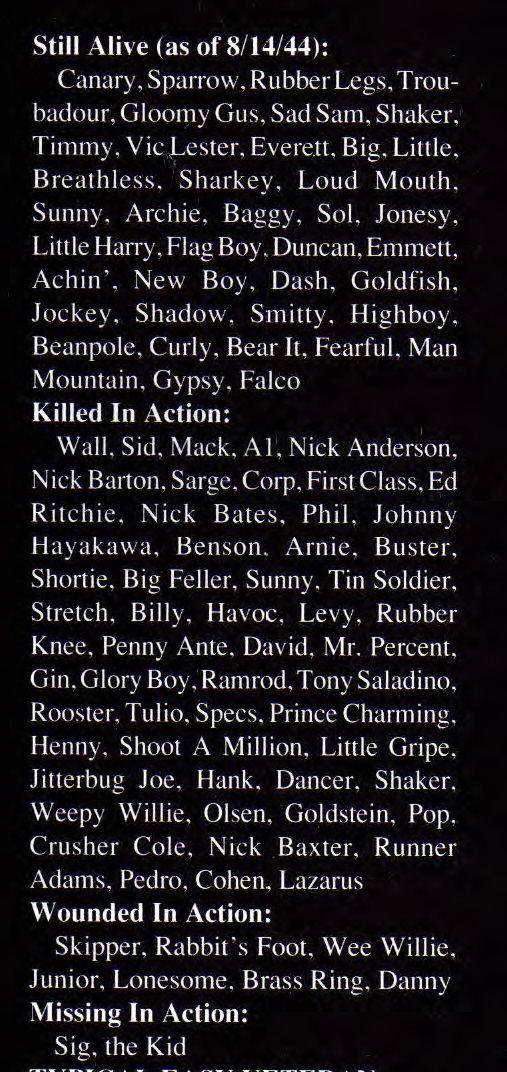
Some were 'star' characters, most were minor. Here is a list of known survivors, deceased, wounded, and missing as of 1944.
THE WAR WHEEL
Ultra-Heavy Rolling Tank ARMOR CLASS 3 [16] HIT POINTS 120 (HD 20) MOVEMENT 18 (L150 x W150) ATTACK x2 Heavy Tank Gun (F), x2 Heavy Tank Gun (R), x5 Heavy Tank Gun (L), x5 Heavy Tank Gun (R) MODIFICATIONS Communications, Firing Port x3 (14 Heavy Tank Guns), Reinforced Hull (x6, 0 damage from Heavy Weapons due to mass and armor), Supercharged Engine
SPECIAL
Crush -
The War Wheel's spiked exterior is made to crush and roll over enemies. It does x6 damage to objects it is rolling over and with it's Reinforced Hull x6 it takes no damage from anything less than another ultra-heavy vehicle or objects (at the War Master's discretion.) It's crew take no damage in a collision unless the War Wheel is actually damaged in a collision.
Vehicle Mishap (OWB Tactical Combat, pg 33)
Due to its gyroscopic design and size the War Wheel ignores the Roll Over result. Roll again.
If a raiding party manages to destroy the gyroscopic mechanism from within, the War Wheel may fall on its side if the Roll Over result comes up.
History
A massive Nazi super weapon crewed by 22 men: fourteen gunners, two drivers, four technicians, a Sgt, and a Captain (Commander.)
The dreadnaught is 150' in diameter and covered in massive spikes. It is incredibly armored and can survive artillery fire. It is vulnerable to bogging down in wetlands.
The first Wheel also had another flaw: electricity. If coming into contact with power lines or other major electrical source the crew will suffer 4d6 damage, Save for half. Later Wheels were insulated against this.
If a squad can get on the Wheel and inside they can shoot their way through several levels of the goliath machine.
Another adventure would be the Allies creating an ultra-damage weapon to do full damage and the squad having to bring it, position it, attack, etc.
A post on running Armored Vehicle combat and stats for such during the Vietnam war.
Not an expert so a few things are probably off to Veteran eye's. I did my best.
Armored Vehicle Movement Driving Checks
The Drive Check is simply a normal Dex roll modified by road conditions, damage, and perhaps even a Class Ability. All penalties and bonuses are cumulative.
Most situations won't call for a check.
Taking damage, encountering and obstacle, a damaged Driver, etc will require a check to maintain control if the tank was moving.
Failure
IF the Drive Check is failed by 1-5 on the roll of d20: Slip
IF the Drive Check is failed by 6-10 on the roll of d20: Skid
IF the Drive Check is failed by 11+ on the roll of d20: Spin
Slip
The vehicle slips to the right or left (random) a number of feet equal to half of the speed it is travelling while continuing to move forward. This can bring it into a collision with another vehicle or objects.
On the Driver's initiative the next round he can roll with no penalty to the Drive check to recover. Otherwise the vehicle must be braked or it plows ahead off course.
Skid
The nose of the vehicle skews to the right or left but the vehicle continue to travels in the direction it was heading side-ways for a distance of feet equal to 1/2 of the speed it was travelling in mph. The Driver must make a Drive Check at the end of the skid or the vehicle comes to an abrupt halt. While skidding out of control it may collide with another vehicles or objects.
Spin
The vehicle spins wildly for the round and ends up facing a random (1d8) direction. If the Driver makes a successful Drive Check with a -4 penalty the vehicle can continue at normal speed if. If failed it skids to a stop after a distance in feet equal to 1/2 of the speed it was travelling in mph, now facing the new direction. If the vehicle hits an object both take damage as per normal collision rules.
Bog Down/Hung Up
Wet environments can suck a tire or tread down fast, bogging the vehicle into an immobile state.
Mud, swampy ground, rice paddies, etc can stop a vehicle fast if care is not taken.
Trying to cross over rubble, tree piles, wide trenches, etc can have the same effect, hanging up the tank and stalling movement.
Whenever failing a Driving check by 5+ while crossing the above conditions or obstacles the Driver must immediately make another check with no penalty. If he fails this one he has become bogged down and unable to continue. He can make one more Drive check with a -8 penalty to free himself otherwise he cannot move without help from another vehicle or a major digging project.
Armored Vehicle Combat Armor and Weapon Ratings
All armored vehicles have an armor rating of Light, Medium, or Heavy.
All armor vehicles are immune to small arms fire, machineguns, and grenades.
Heavy weaponry have the same ratings and affect how they damage vehicle armor based on these ratings.
⦁If the weapon is the same rating as armor the vehicle will take full damage.
⦁If the weapon is one rating lower than the armor the vehicle will take half damage.
⦁If the weapon is two ratings lower than the armor the vehicle will take no damage.
Hard and Soft Targets
Sometimes in tank combat it's important to know how hard or soft a target is that you're shooting or ramming into. If it comes up here are guidelines:
⦁Hard Target: Armored vehicles, metal and concrete buildings and bunkers.
⦁Soft Target: Open trenches, unarmored vehicles, wooden buildings, etc.
Vehicle Damage
⦁At half hit points the vehicle is at a -2 penalty to drive due to damage.
⦁At 0 hit points the vehicle is immobile.
⦁At -10 hit points the vehicle is either on fire as per the Fire critical result
⦁At -20 or lover the vehicle explodes as per the Boom critical result.
Critical Hits
A roll of a natural 20 on the 1d20 attack roll is considered a critical hit and, if it does damage to an armored vehicle, causes a roll on the critical hit chart in addition to damage to the vehicle hit points. Because of the armor rules a Light vehicle weapon might hit a Heavy armor vehicle doing no damage and negating the critical hit.
Every damaging hit to the vehicle when it is at half of it's current hit points or greater is cause for a roll on the critical chart.
Find where the gunner was aiming and roll in the appropriate area (Turret, Hull, Treads) to see what happened.
APC Crits
1.Driver compartment hit. Driver takes full damage, Save for 1/2 damage. See Crew
2.Gunner MG:Destroyed.
3.Gunner hit. Gunner takes full damage, Save for 1/2.
4.Radio: Destroyed
5.Passengers: Random roll for full passengers ( 8 passengers = 1d8, etc.) hit for full damage, Save for 1/2 damage.
6.Engine Hit: The vehicle is now at half speed. If hit again the engine is destroyed. If the first hit is by five or more over the AC the engine is immediately taken out.
7.Fire: The vehicle is burning. The vehicle and all crew take 2d6 damage per round. It increases by 1d6 per round until the vehicle destroyed.
8.Boom: The vehicle explodes in fire and shrapnel as fuel or ammo or both ignite. The crew takes full damage from the attack and an additional 3d6 fire damage each round inside the vehicle. Those within a 50' radius of the vehicle takes half damage from the attack damage, Save for 1/4 damage.
Treads/Tires
There is no chart to roll. The treads are hit and damaged. Drive rolls suffer a -4 penalty. If hit again the vehicle is immobilized. If the first hit is by five or more over the AC the vehicle is immobilized.
Tank Crits Turret
1.Main Gun: The first hit causes a -4 penalty to all shots from damage. A second hit destroys it. If the first hit is by five or more over the AC the gun is immediately destroyed.
2. Crew: 1d3 crew (commander, gunner, loader) hit for full damage, Save for 1/2 damage. See Crew Hit Chart below.
3.Turret Jam: Stuck at current position.
4.Co-Ax (turret) MG:Destroyed.
5.Hatch torn off. If Commander standing in it he takes full damage, Save for 1/2.
6.Turret Explosion: It's gone. All crew take 5d6 damage, Save for half.
Hull
1.Radio: Destroyed
2.Bow MG: Destroyed
3.Crew: 1d4 crew (see below for random crew hit chart) hit for full damage, Save for 1/2 damage.
4.Engine Hit: The vehicle is now at half speed. If hit again the engine is destroyed. If the first hit is by five or more over the AC the engine is immediately taken out.
5.Fire: The vehicle is burning. The vehicle and all crew take 2d6 damage per round. It increases by 1d6 per round until the vehicle destroyed.
6. Boom: The vehicle explodes in fire and shrapnel as fuel or ammo or both ignite. The crew takes full damage from the attack and an additional 3d6 fire damage each round inside the vehicle. Those within a 50' radius of the vehicle takes half damage from the attack damage, Save for 1/4 damage.
Treads/Tires
There is no chart to roll. The treads are hit and damaged. Drive rolls suffer a -4 penalty. If hit again the vehicle is immobilized. If the first hit is by five or more over the AC the vehicle is immobilized.
Crew Hit Chart
(multiple hits on the same crew member count and diminishes hits due to other crew.)
⦁1-2 Commander
⦁3-4 Gunner
⦁5-6 Loader
⦁7-8 Driver
Aiming At an Armored Vehicle
With an extra -4 penalty on the roll the attacker, if a crit is scored, can choose a critical effect.
⦁Turret: Main Gun, Crew, or Turret Jam
⦁Hull: Crew or Engine Hit
⦁Treads/TIres
Ramming and Collisions
To successfully ram a vehicle or other object a Driver must make a Drive Check with a +4 bonus. If successful the vehicle plow into its target. Tanks are good at ramming things, especially smaller vehicles.
If a vehicle is hit the rammed Driver must make a Drive Check or lose control. If the attacking Driver fails and rolls a natural 1 or 2 on the d20 the attacking Driver must make a Drive Check of his own or lose control.
If two vehicles are attempting to ram each other, each Driver makes a normal Drive Check with a +4 bonus. Whomever makes the highest roll has the advantage; the other Driver must make a second Drive Check or wreck his vehicle. If both miss, nobody hit. If it's a tied roll, both take damage and both make Drive Check to see if they lose control.
Damage
Crashing or ramming vehicles take 1d6 points of damage for every ten miles per hour they are travelling. Armored vehicles multiply this damage: x2 for Light armor, x4 for Medium armor, x8 for Heavy armor.
Against unarmored vehicles a Light armored vehicle takes 1/4 damage. For collisions with other armored vehicles damage is reduced the same as if the opposing AV is a weapon of the same rating as its armor. Thus a Heavy armor tank ramming a Light armor tank would take no damage; the light tank would take full damage.
⦁If a Vehicle rams another from behind subtract the target Vehicle's mph from the ramming Vehicle's mph. The remainder is the damage to both Vehicles and Drive Checks are required as normal. .
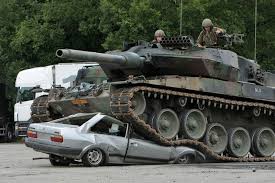
⦁If a Vehicle T-bones another vehicle both take the damage from the ramming vehicle's mph. Unarmored vehicles or armored of the same rating come to a dead stop. Smaller armored vehicles are knocked aside. An armored vehicle will plow over or through a smaller unarmored vehicle.
⦁If two Vehicles hit head-on add the amount of d6 damage from BOTH Vehicles mph and add them together for damage. Unarmored vehicles or armored of the same rating come to a dead stop. An armored vehicle will plow over or through a smaller unarmored vehicle.
When ramming buildings etc use the following guidelines adjusted for fortifications, etc.
⦁Hard targets: concrete buildings and barricades rate as Light armor, heavy steel rates as Medium armor.
⦁Soft Targets: Normal wood and earth rate as no armor or Light armor if thick trees, etc.
Sideswipe/Grazing//Pushing
Grazing a vehicle as a sideswipe does 2d6 damage to each vehicle and none to the Passengers. For armored vehicles follow the same damage guidelines as above. A sideswiped Driver must make a Driving check or lose control.
Pushing another Vehicle off the road or into obstacles is a Ramming Maneuver as above.
Passenger Damage
Passengers take half damage from all wrecks and collisions (except for grazing/sideswiping.)
Damage is whatever is left over from a vehicle after being reduced by armor, etc.
Passenger damage can be reduced by the following:
⦁A seat belt reduces the damage by 25 percent.
⦁A Saving Throw (Death) allows the Passenger to reduce the remaining damage by 50 percent.
Damage reduction is cumulative and follows the order of seat belt then Save.
If a Passenger in the Vehicle is brought below 0 hp but has more than -10hp he can make a Saving Throw (Death). IF successful the Passenger is stabilized but unconscious and in critical condition. For each hour they are without medical help they must roll another Saving Throw or die.
If they are at -10 hp or lower or the after wreck Saving Throw is failed the Passenger is dead at the wreck.
Injured Driver
A Driver at half hit points or lower have a Drive check penalty of -4.
Armored Vehicle Profiles
A quick explanation of a few vehicle game stats.
Armor Class (Ac)
Normal armor class to be hit. (Light, Medium, or Heavy armor.)
Hit Points (HP)
How many hit points the vehicle normally has.
Move
Maximum mph for the vehicle. To find combat movement in relation to characters us the following quick and easy way: Every 1 mph the vehicle is moving multiply by 10'.
(ex: 25 mph equals 250 feet per round.)
Range
The miles the tank can travel on a full tank of fuel.
Armament
Where the weapon is mounted:
⦁Turret: the main weapon of the vehicle, usually a cannon or launcher.
⦁Pintle: a machine gun on a swivel mount, placed near a gunner hatch on an APC and a Commander's hatch on a tank.
⦁Coaxial: a machine gun mounted in the turret aligned next to the cannon. It moves with the turret.
⦁Bow: a machine gun mounted on a swivel in the front hull of the tank.
Caseless Ammo: When hit with a turret or hull critical there is a 70% that the rocket or mine sets off the ammo outright destroying the tank and killing everyone inside in an inferno.
Tank Cannon/Guns
Here are some cannon stats for tanks.
The base damage is based on the High Explosive (HE) shell. There are three increments to the radius as in my Artillery rules here. This damage is used and modified for other shells.
Shell Types High Explosive (HE, tipped with an explosive warhead.)
Standard damage round. Most effective against soft targets and infantry.
High Explosive Anti-Tank (HEAT, a shaped HE warhead designed to penetrate tank armor.)
An extra x1 to damage vs vehicle. Explosion arcs out in a 180' arc from point impact on vehicle or hard target. Automatic half damage to soft targets (personnel, animals, etc.) and may Save for another half damage.
White Phosphorus (WP, incendiary shell.)
Explodes in the normal radius for the shell. It burns for 2d6 damage for six rounds.
Damage is not reduced by radius increment but those hit do receive a bonus to their Saving throw for half damage. The second increment gives a +2 bonus to the Save and the third increment gives a +4 bonus to the Save.
Canister//Beehive round.
Similar to the artillery version it is a shell packed with thousands of flechettes (small darts like nails). It is a vicious area effect weapon used against personnel especially those hidden in dense foliage. this shell does 3d6 damage to all targets in a cone attack starting 2' wide at the firing weapon and extending in a cone 1200' in length and a 300' width at it's end.
⦁Everyone and everything not undercover can make a Saving Throw for half damage.
⦁Those under soft cover automatically take half damage and can make a Save to halve it again with a bonus to the Save equal to cover bonus.
⦁Those under hard cover or in an armored vehicle take no damage if totally covered. If partially exposed they will take damage and Save as if under soft cover above.
Because if the rarity of tank to tank combat the most popular shells were HE and canister. WP was useful but dangerous if hit in a tank. AP and HEAT were the least used.
Armor Piercing (AP, non-explosive solid rounds.) Rarely use in Vietnam.
An extra x1 to damage vs vehicle.
(Ex: a 75mm AP round would do 5d6x3, not x2.)
NVA/VC Anti-Tank Weapons
The communists used a popular Chinese 75mm Recoilless Rifle. It was light and had a good punch.
Functions the same as the 75mm tank cannon.
Armed with HE and HEAT rounds.
Smoke/Smoke Mortars
Smoke from explosions, fires, etc can play havoc in vehicle combat. An obscured vehicle is more difficult to hit, just as an obscured character is, and can hide movements. An obscured vehicle receives an AC bonus or +2 to +6, but it also takes a penalty equal to this amount if attacking from within the smoke. If an obscured vehicle fires from within the smoke it gives its position away and its AC bonus is halved. .
Smoke mortars on vehicles create a wall of smoke that will obscure it and its movement for 1d6+2 rounds. Smoke/WP shells could also be fired towards an enemy to cause confusion.
Cover
Vehicles can take advantage of cover such as burned out buildings, trees, and shallow depressions in the ground (going 'hull down.') Cover works the same as for a character giving a bonus based on how much of the vehicle is hidden. Camouflage netting may aid in the cover bonus.
For hard cover such as a concrete/brick walls or hiding behind a rocky hillside or burnt out tank:
+2 AC light, +4 for medium, and +6 for heavy cover.
For soft cover such as trees, an earthen hillside, etc. halve the cover bonus.
Rules suggestions for Artillery and big explosions.
Blast Radius
Artillery, tank cannon, and other big guns have a large blast radius. There are three extending blast radius' measured in feet. The further from the center of the explosion the less damage personnel and vehicles will take.
There are three incremental radii to such explosions, each measured in feet.
The first radius extends a set amount of feet. (For example let's say 20')
Multiply x2 feet for the second. (21' to 40')
Multiply x3 for the third increment. (41' to 60')
Damage done by Radius:
First: Full damage dice. Personnel (your men and the enemy combatants) Save for 1/2 damage.
Second: half damage dice (round up.) Personnel Save for 1/2 damage.
Third: half again damage dice (round up.) Personnel Save for 0 damage
Cover bonus applies to saving throw.
Full cover may completely protect a character if the DM decides it is strong enough (use the light, medium, heavy armor/weapon rating for Vehicles below for guidelines.)
Basic Artillery Rules
There are several options available. A few are: WWII Operation White Box by James Spahn
All work very well and all pretty much work the same in each system:
⦁ You use your own mortar or you call in to see if Heavy Artillery is available.
⦁ Some roll is made to see if it is available/ what is available/ how much is available.
⦁ Rolls are made to see how long before the barrage will begin.
⦁ Rolls are made to see if/how close artillery hit.
⦁ Rules to do various things such as re-adjusting hits on the target, firing for effect, etc.
Heavy Arty Availability
Some missions will not have Heavy Artillery available due to it being diverted for other operations, stealth concerns, etc. It will vary.
When available on missions Heavy Artillery should be used sparingly. Over calling will result in it not being available as some REMF decides you do not need it. As a DM more than once a day for non-dedicated non-search-and-destroy target missions will be about it. Dedicated fire support will most likely be readily available as specific targets are located, not to get the PC's out of every fire fight.
If the team's mission has been given dedicated fire support it is vastly more likely it will be available. If not the chances of having support are greatly reduced. It's a crap shoot. At one point in time there were over 200 batteries of artillery were scattered over the country and often fire could overlap.
When in the field and the PC's think they need it they must roll to see if fire support is available
Roll a 1d6. A roll of 5 or 6 indicates it is available.
⦁Dedicated: +3
⦁Non-Dedicated: +0
What's available?
Roll a 1d6:
1 Heavy Mortar
2-3 Heavy Artillery
4-5 Gunship
6 Air Strike
How Long?
Average response time is 60 to 90 seconds.
Find how many points under his Int/Radio check the FO succeeded on his roll.
Subtract this from 15 to find how many rounds it takes for the first shell to impact (minimum 6 rounds.)
How to Hit? (Forward Observer)
Heavy Mortar and Artillery
To target the enemy and to make adjustments to the roll requires an Intelligence/Radio check. Those unskilled have a -4 penalty to the check. After the response time has elapsed a single spotting round will impact the ground on the FO who called it in's initiative. This will be the initiative for any following shells.
If the FO roll is passed the strike is on target. If it is failed the shell deviates from its intended target and lands in a random direction (use the 1d8 or 1d12 clock method) landing 2d10 x50 feet off target.
Re-Adjusting Fire
The next round the FO can call in another spotting round and try to hit the intended target with a +4 bonus to the FO roll (and a +8 if he takes another round after this but +8 is the maximum.) If successful the re-adjusted fire hits and he can call in a Fire or Effect barrage. If failed the shell deviates but lands only 2d10x20 feet off target. This will be the deviation the next round, etc.
The FO can 'walk' the rounds over to a new target this way.
Fire for Effect (FfE)
When the target has been hit the FO can call for Fire for Effect. The battery fires with all of its guns and loaders.
⦁Multiple shells impact on each combat round equal to it's rate of fire (RoF.)
⦁The duration shows how many rounds the barrage lasts before the battery is exhausted, redirected, etc. A new strike, if called immediately after, gains a +8 to the FO's roll.
⦁The shells are not as accurate as a spotter round . Roll the deviation for each shell that round.
Canister//Beehive round.
A 105mm shell packed with thousands of flechettes (small darts like nails). It is a vicious area effect weapon used against personnel especially those hidden in dense foliage. The shell does 4d6 damage to all targets in a cone attack starting 2' wide at the firing weapon and extending in a cone 1200' in length and a 300' width at it's end.
⦁Everyone and everything not undercover can make a Saving Throw for half damage.
⦁Those under soft cover automatically take half damage and can make a Save to halve it again with a bonus to the Save equal to cover bonus.
⦁Those under hard cover or in an armored vehicle take no damage if totally covered. If partially exposed they will take damage and Save as if under soft cover above.
Gunship
Gunships will come in and chew up a position. They will stick around until they start taking serious ground fire (especially RPG's) or run out of ammo. Each round they will unload with all available weapons on the ship.
Pilot(s): Attack +2, +3 to Dex/Piloting
Gunners: Attack +3
Hog (Huey)
Two M-60's, door gunners.
⦁Target up to six hostiles per round in a line ten feet wide and fifty feet long.
⦁+4 to hit.
⦁Damage: 4d8 per hit.
40mm automatic grenade launcher, nose, pilot.
⦁Attacking Ac 10 (Area attack)
⦁Blasts an area up to thirty feet wide and 100 feet long per round.
⦁Damage is 6d6. Soft targets save for half.
2.75 in (70 mm) rockets - M200 19-tube rocket launchers, 2 pods, pilot.
⦁Attacking Ac 10 (Area attack)
⦁Blasts an area 40' wide by 40' per pair of rockets fired. Can fire up to up to 36 pair per round.
⦁Damage: 6d6, Light Weapon, Soft targets save for half.
Snake (Huey Cobra)
7.62 mm multi-barrel Miniguns, right front turret, pilots.
⦁Target up to 12 hostiles per round in a line ten feet wide and 100 feet long.
⦁+4 to hit.
⦁Damage: 4d8x2 per hit.
40mm automatic grenade launcher, left front turret, pilots.
⦁Attacking Ac 10 (Area attack)
⦁Blasts an area up to thirty feet wide and 100 feet long per round.
⦁Damage is 6d6. Soft targets save for half.
2.75 in (70 mm) rockets - 19-tube rocket launchers, 1 or 2 pods on each wing, pilots.
⦁Attacking Ac 10 (Area attack)
⦁Blasts an area 40' wide by 40' per pair of rockets fired. Can fire up to up to 36 pair per round.
⦁Damage: 6d6, Light Weapon, Soft targets save for half.
Airstrike
Napalm, bombs, or possibly AC-47 Spooky (Puff the Magic Dragon.)
Whole sections of the jungle go away. Hills get flattened. Bunkers crack like eggs. Fire and the wrath of Uncle Sugar. The scale of this kind of devastation is almost unimaginable from the ground.
Currently beyond the mechanical scope of what I want to do. Maybe later.
For now the GM will decide the outcome of an airstrike.
If it gets too close to the PC's and allies may take a few dice of damage at the GM discretion. Good luck.
Mortars
The attack roll uses the gunner or FO's base hit bonus + Int modifier vs a stationary target Ac of 10 + range modifiers. A moving target is always Ac 20 plus range modifiers and only one shot per round can be taken.
If it is failed the shell deviates from its intended target and lands in a random direction (use the 1d8 or 1d12 clock method) landing 2d10 x25 feet off target.
Once on target no attack roll is needed for a stationary target but deviation is rolled for each shell. IF the target moves to a new location the mortar must re re-adjusted.
USA/ARVN MortarDmg Inc'RoFRange' Deviation Light
M-2 60mm5d6 15' 2 500'1d6x5 feet
⦁ 60mm WP2d6 (Burns for six rounds)
Medium
M-29 81mm8d6 25' 2 1000'1d10x5 feet
⦁ 81mm WP2d6 (Burns for six rounds)
⦁ 81mm Parachute Flare (up 1800 feet and light up a 3000 ft area for 1 minute)
NVA/VC
The communist forces used a 60mm and an 82mm, both equivalent to our 60 and 81mm.
Mortars and their shells are heavy. Most mortars break down into three pieces: tube, bipod, baseplate. The baseplate is the heaviest, half the weight of the mortar. The M-19 60mm is split among a three man crew (squad leader, a gunner, and a loader.) The M-29 81mm normally crewed by a 5 man team (squad leader, a gunner, an assistant gunner and two loaders.)
Artillery vs Vehicles
⦁Vehicles caught in the radius of a mortar take damage normally depending on their armor rating vs the mortar rating
⦁A direct hit from a 150+ mm HE shell from above straight up destroys the vehicle and everyone takes full damage. Everyone in the tank then is on fire for 2d6 damage per round until they escape the vehicle. Everyone within the three radii of the shell take normal damage with Saving throws.
I am forty-six as of this writing. I will always have a strong interest in the Vietnam War.
It was my uncle's war, it was my friends dad's war. It ended almost three years after I was born but we grew up in the shadow of it. Slowly at first, few people cared to talk about it in the seventies, especially to kids. You got a sense or shame, of regret, or other signs of pain. It seemed like people wanted to forget. We weren't taught about it in school. I saw John Wayne's film the Green Berets but it felt off, not quite right. Gradually, especially during the early eighties, we learned more about it thanks to pop culture interest: First Blood (Rambo), the Chuck Norris Missing in Action movies, Platoon, Hamburger Hill, Full Metal Jacket, etc. Then TV shows such as China Beach and Tour of Duty. And comic books, most notably Marvel's classic The 'Nam. We were finally allowed to learn about it. And it is fascinating. As with generations of veterans and civilians of other wars we got our tales of men who only wanted to survive to get home from that terrible time that people didn't want to talk about for years. They have joined the ranks of heroes bestowed to our Grandfathers and Great-grandfathers from Korea and the World Wars.
It may seem strange to younger kids now, but that's how it was.
We have naturally turned to gaming as we do everything. I think a lot of us as DM's try to express our 'artistic side' by running games, creating and re-creating worlds and time periods. My uncles were Vietnam vets (now dead) and I took care of dozens of veterans from Vietnam to as far back as one WWI soldier. This one is a lot more personal and I mean no insult to anyone on ANY side of the war. This is written from the American viewpoint. As with any war we don't want to denigrate the horror that is actual war and not play war. Due to the nature of this one I find it a bit..... unnerving? I'm not sure of how to describe it. It's a feeling of not wanting to somehow 'fail' to show the horrors and 'cheapen' it. It's hard to articulate this feeling other than I hope we are not insulting their memories by turning the war into a game play. I don't feel this way about other wars only Vietnam. Personal hangup? The muddled nature of the war?
On to gaming.
Get a copy of Recon (Advanced or Deluxe Revised.) It was a big influence on this. It was the first Vietnam dedicated RPG I ever owned and it is still amazing. I love that game and it has a number of excellent charts for almost everything: encounters, villages, traps, ert as well as a simple vehicle system that can be used if you simply figure out cover bonuses. All good stuff and cheap on pdf and otherwise.
There is an amazing amount of info on the War and that time in history.
For our purposes the the most useful would be info on the war itself:
Maps of the War
Basic History of the War
Military info on American/Allied and NVA/VC armed forces.
Campaigns and major battles (several wargame sites actually have good info, maps, and troop movements for these to recreate and use for your games.)
We are using my Survival Horror OSR for quick character building and a wider spread of skills/abilities. Combat is still standard Classic D&D few few modifications.
I have run several adventures with this ruleset over the years: mostly action (John Wayne's Green Berets again) or weird war/horror. As with other Classic D&D and OSR rulesets it runs quickly and fairly smoothly. We had a good time. The nature of lower hit point characters lends itself well to infantry combat.
I also have actual character classes which I'll post later for whose who want even more classic character class versions for the system.
Vietnam Military Packages
Built for 2 hd characters with 12 points for abilities/skills.
All except medic and special forces have spare points to spend. Feel free to arrange any points to lower or raise certain skills for individuals.
American/Allies Arsenal
Rifles
M-16A1 5.56mm, Semi/auto
2d6/150'/20 or 30 magazine
Feed reliability was an issue with these magazines. A fully loaded 20 round magazine jams on a natural 1 or 2 roll. Loading only 18 rounds drops it back to 1.
It takes 1d6 rounds to clear the jam.
30 round magazines were introduced in 1967 with special forces, became more common by 1971.
The 30 round magazine has the same issues with reliability unless 28 or less rounds are loaded.
XM-177E2 "Colt Commando", 5.56mm, Semi/auto
2d6/100'/20 or 30 magazine
This weapon has the same magazine loading issues as the M16.
M-2 Carbine .30, Semi/auto
1d10/80’ /15 or 30 magazine
XM21 Army Sniper Rifle, Semiautomatic A modified M-14. 2d8/200’/ 5 internal magazine Telescopic Sight: +4 bonus to attacks when aiming (stacks with the aim maneuver.)
Smith & Wesson .44 magnum, Revolver
1d10+1/30'/6 cylinder
SubMachine Guns
Ingram Mac 10, 9mm, Semi/auto
1d6/50'/32 magazine
Ingram Mac 10/ M3A1 "grease gun", .45, Semi/auto
1d8/60'/30 magazine
Thompson, .45, Semi/auto
1d8/80'/20 or 30 magazine
Shotguns
Shotgun, .12 ga, Break or pump
2d8*/50’/2 or 5 break or pump
Sawed Off, .12 ga, Break or pump
2d8*/20'/2 or 3 break or pump
*Slug damage (2d8)
* Shot damage (3d6/2d6/2d6/1d6/1d6) by range increment (5 increments)
Shotguns loaded with buckshot receive a +2 hit in the first range increment.
Machine Guns
M1919 Browning .30, Auto
2d6/200'/100 belt
M-60 7.62mm, Semi/auto
2d8/200'/100 belt
M-2 .50 BMG
2d12/200'/100 belt
Grenades
Fragmentation Grenade
⦁Damage is 3d6 out to the first 20', 2d6 21 to 30', 1d6 31 to 40'. Save for half damage.
⦁The throwing increment is 20'.
⦁The M26/61 and M33/67 have a delay fuse.
⦁The M59/68 explodes on impact.
MK 3A2 Offensive Hand Grenade
⦁Concussion grenade, little shrapnel, short damage range outside, incredibly lethal in enclosed areas.
⦁Damage is 2d6 outside out to 10', 1d6 at 11' to 20'. Save for half damage.
⦁Damage inside is 4d6 out to a solid wall or 30', whichever comes first. Save for half damage.
Smoke Grenade
⦁Lasts 1d4 +6 rounds.
⦁The M-8 is standard white while the M-18 comes in red, yellow, green, or violet.
M14 TH3 Incendiary Hand Grenade
⦁Damage is 2d6 out to the first 20', 1d6 out to 60'. Save for half damage.
⦁The damage is continuous for 6 rounds.
⦁The throwing increment is 20'.
⦁It has a 4 to 5 second delay fuse.
M-79 40mm Grenade Launcher
⦁Standard High Explosive damage is 3d6 out to the first 10', 2d6 11 to 20', 1d6 21 to 30'. Save for half damage. The range increment is 100'.
⦁Grenade shells must go 10' before arming. Otherwise damage is 1d10 from impact.
⦁Common shells are HE, white phosphorus, smoke, CS gas, and parachute flare.
⦁The M-79 can also fire a multiple projectile round (basically a big shotgun shell.) capable of hitting a target and to all enemies within 5' of the target if the attack roll is high enough to hit them as well. This shell has a range increment of 50' and gives a +2 bonus to hit within the first increment. There are five range increments and damage is affected by the range increment: 4d6/3d6/2d6/2d6/1d6.
The M-79 can be fired and reloaded once per round with a -3 to the initiative roll (1d6+ Dex bonus.)
In 1969 the US introduced a reliable underslung single shot, the M203.
Treat as an M79.
Explosives,Rockets, Etc
Claymore Mine
⦁Damage is a 5d6 area attack in a 60 degree arc out to 150'. Everyone not under cover can still Save for half damage.
⦁The explosion has a back bast of 40' in a 180 degree rear arc doing 3d6 to anyone in this area. Save for half damage.
C-4
⦁One pound block. Must be set off with a detonator.
⦁Damage is 5d6 per pound out to 10', -1d6 per ten feet after.
⦁Each extra block adds 2d6 to the blast.
⦁If shaped it is a Heavy Weapon.
Det Cord
⦁Must be set off with a detonator.
⦁Five feet of det cord does damage of 2d6 fire to with a five foot area. Can be doubled up which adds another 1d6 to the damage. Maximum damage this way ius 4d6,
M72 Light Anti-Tank Weapon (LAW)
⦁Damage is 8d6 out to 50', 4d6 51 to 80', 2d6 81 to 100'. Save for half damage.
⦁Range increment is 100'.
⦁Medium Weapon
M2A1-7 Flamethrower
⦁At full capacity the tanks have enough for 7 bursts of flame. One burst gives the operator an arc 30' wide x70' long. The arc can be doubled at the cost of two bursts.
⦁It is an area attack weapon and the operator needs to only roll for for a malfunction (natural 1-3 on 1d20.) Everyone caught in the area of attack takes 2d6 damage and can make a Saving throw for half damage with a bonus to the Save equal to Cover bonus. This damage total is applied for six rounds unless the character is immersed in a body of water or a fire extinguisher is used.
⦁If the tanks are hit with a piercing weapon the weapon is rendered useless.
Armor
Flak Vest
+2 to AC vs Handguns and SMG's.
+4 to Saving Throws vs shrapnel damage.
The vest is hot and heavy. It costs the wearer a 1 penalty on all personal rolls (attacks, attributes/abilities/skills, etc.)
Helmet
+4 to AC for head shots vs handguns ammo/+2 vs rifle ammo and +1 to Saving Throws vs shrapnel. (50 percent chance of coverage.)
VC Thompson Copy, .45, Semi/auto
1d8/80',/20 or 30 magazine
Machine Guns
Chinese Type-24, 7.92mm, Auto
2d10/200'/250 belt
Soviet RPK, 7.62mm, Semi/auto
2d8/200’/ 40 magazine or 75 drum
Grenades
Fragmentation Grenade
⦁Damage is 3d6 out to the first 20', 2d6 21 to 30', 1d6 31 to 40'. Save for half damage.
⦁The throwing increment is 20'.
⦁Delay fuse.
Anti-personnel Hand Grenade
⦁Concussion grenade, little shrapnel, short damage range outside, incredibly lethal in enclosed areas.
⦁Damage is 2d6 outside out to 10', 1d6 at 11' to 20'. Save for half damage.
⦁Damage inside is 4d6 out to a solid wall or 30', whichever comes first. Save for half damage.
Incendiary Hand Grenade
⦁Damage is 2d6 out to the first 20', 1d6 out to 60'. Save for half damage.
⦁The damage is continuous for 6 rounds.
⦁The throwing increment is 20'.
⦁It has a 4 to 5 second delay fuse.
Rockets, Explosives, Etc
RPG-7
⦁Damage is 6d6 out to the first 20', 3d6 21 to 40', 2d6 41 to 50'. Save for half damage.
⦁Range increment is 150'.
⦁Heavy Weapon
Armor
Helmet
+2 to AC for head shots and +1 to Saving Throws vs shrapnel. (50 percent chance of coverage.)
Hand Weapons
As the American/Allies above.
Captured/Improvised Weapons
The VC had a very mixed bag of older weapons such as WWII Nazi surplus and firearms and explosives captured from first the French the the Americans and our allies.
That's not even counting the home-made or reworked junk firearms into single shot pistols, carbines, etc and home-made coke can grenades and improvised explosives.