An oldie but a goody.
Here's the pdf for my Scooby Doo .... F'taghn! adventure for Savage Worlds I wrote about five years ago.
UPDATE March 15, 2020.
Link fixed.
Tuesday, February 3, 2015

Pay for your coffins....Django and Sartana are coming! (OSR in the American West.)
Re-edited and re-posting from the old Blog.
We had a lot of fun with this one.

The game can be run one of two way: Traditional John Wayne, Randolph Scott westerns or the Clint Eastwood, Italian Spaghetti Westerns. Traditional is grounded in more 'realism' whereas the Spaghetti's are all about style and violence.
Rolling Attributes
Pick your favorite method.
Attribute Bonuses/Penalties
Either the standard Swords & Wizardry +1 or Labyrinth Lord’s +1 to +3.
For Traditional: I prefer the S&W method.
For Spaghetti's: I prefer the latter as it gives a wider range to class special abilities and to Fast Draw.
Armor Class
Normal Armor class, and modifiers are used.
Firearms ignore the first four points of personal armor. For example: Plate –6 [+6] would only give protection of –2 [+2].
Starting Money
Characters begin with 3d6 x $20 as first level characters. Characters starting off at higher levels receive an amount of beginning money equal to 3d6 + the characters level x $40 or whatever their DM feels is appropriate to the game.
CHARACTER CLASS
Cowboy
Gambler
Gunslinger
Lawman
Scout
Soldier
Experience, Saving Throw, To Hit
Each class uses the Fighting Man experience table, Saving throw, and receives a +1 to hit at each level.
Level Limit
There are none beyond the standard 20th level. However, in Traditional westerns even the best heroes are rarely beyond level 10 or 12 in skill. Higher levels than this should be ultra-rare, perhaps the best in the West.
Hit Points
Traditional: HD limit of 5th level. Skills increase past this but HP's are locked at fifth.
Spaghetti: Roll for them at each level as per normal rules. Spaghetti heroes take massive amounts of punishment before giving up the ghost.
Multi-Class
The classes are constructed for the characters to easily multi-class between levels if they desire. As an option, the DM may want to limit multi-classing by only allowing the character to take a new class if they have an ability score bonus in the Prime Attribute of the new class. Abilities do not stack.
Cowboy (Cowpoke, Gaucho, Cavalry, etc.)
Hit Die Type 1d6+2, After reaching 10 hit dice, the Cowboy gains only 2 hit point per level
Prime Attribute (5% xp bonus) Con 13+
 Marksman
Being proficient with firearms is a necessity on the trail. With snakes, coyotes, bandits, and hostile Indians you have to learn to defend yourself.
The Cowboy receives a +1 to hit with all firearms.
Roping
The Cowboy receives a +2 bonus with the lariat (ranged attack).
Gambler (Gambler, Con-Man, Thief, etc.)
Hit Die Type 1d6, After reaching 10 hit dice, the Gambler gains only 1 hit point per level
Prime Attribute (5% xp bonus) Int 13+

Backstab
When attacking with surprise, from behind, the Gambler gains +4 to hit and inflicts double damage. At levels 5-8, damage is tripled, and from a Gambler above level 8 such an attack inflicts quadruple damage.
Fast Talk
With a bit of conversation, the Gambler is able to attempt to befriend, persuade, charm, or outright con an individual to his way of thinking. After 2d6 minutes of cajoling, flattering, drinking, etc. the victim of the Fast Talk must make a Saving Throw. This Saving Throw has a cumulative -1 penalty roll for the Gambler levels 1, 5, 10, 15, and 20.
Gambling
The Gambler is a cardsharp, making his living by the cards and his wits. At levels 1, 5, 10, 15, and 20 the Gambler gains a cumulative +1 bonus to his gambling checks.
Hear Noise
The Gambler has honed his hearing to eavesdrop to hopefully pick up juicy bits of information or to listen for disturbances while on a bit of thievery. His chance to hear noise is 3 in 6 at first level increasing to 4 in 6 at 3rd level, 5 in 6 at 7th level, and 6 in 6 at 11th level. To use this ability he must stop all activity and concentrate.
Open Locks
Gamblers are skilled at picking locks, opening safes, etc. Some are difficult and may require a penalty to the open roll. The base chance for success is 10 + 1/2 level + Dex bonus on a d20. Superior tools may grant a small bonus just as inferior tools may incur a small penalty.
Pick Pocket
The Gambler is often called upon to manipulate small objects, such as a card, coin, derringer, or small knife in his line of work, as well as picking the occasional pocket. The base chance for success is 10 + 1/2 level + Dex bonus on a d20.
If the Gambler fails his roll the victim has a 1-2 in 6 chance of detecting the manipulation, pick pocket attempt, etc. A Dex bonus will drop the chance to 1 in 6. See Gambling below.
If the Gambler rolls a natural 20, he has been spotted by his victim or victims if he is picking a pocket, cheating, etc.
Gunslinger (Gunman, Bounty Hunter, etc)
Hit Die Type 1d6+2, After reaching 10 hit dice, the Gunslinger gains only 2 hit point per level
Prime Attribute (5% xp bonus) Dex 13+

Fast Draw
A Gunslinger gains a cumulative +1 bonus to initiative while wielding a firearm at first level and later levels.
3, 6, 9, and 12
The Gunslinger does not receive a -4 penalty to attack for drawing a weapon and attacking in the same round.
If group initiative is used, the Gunslinger still rolls for individual initiative.
For Example: A 6th level Gunslinger with a +2 Dex bonus wielding a Heavy Pistol (-1 initiative) with a fast draw barrel (+1 initiative) draws his firearm. He rolls the 1d6 for initiative and gets a 3. The penalty for drawing a weapon is -3. His total is : 3 rolled, -3 for drawing, +2 Dex bonus, -1 for Heavy pistol, +1 for the fast draw barrel equals an initiative total of 2 initiative.
Steely Gaze
At 1st level, the Gunslinger can intimidate a number of creatures with HD equal to his level. The creatures must be able to see the Gunslinger’s stare to be affected. The creatures are allowed a Saving Throw to avoid this effect. Those that fail suffer a –2 to all attacks on the Gunslinger. Most will flee; only the most determined will stay and fight.
This ability can be used 1 per day per Gunslinger level.
Extra Attacks
Receive an extra attack at levels 5 and 12.
The attacks can be a mix of both melee and ranged attacks (although pulling a ranged weapon and firing in the same round incurs a -4 penalty to all attacks taken after the ranged weapons is pulled.)
Off-hand penalties do not apply to the extra attacks, only the one off-hand attack from using a second weapon. The extra attacks are considered to be used with the primary hand,
Maneuvers such as fanning the hammer, fast firing double-action pistols with penalties, or auto-fire CAN be taken with the extra attacks. Each extra attack is at the same penalty as the maneuver attacks.
Lawman (Sheriff, Texas Ranger, Pinkerton, etc.)
Hit Die Type 1d6+2, After reaching 10 hit dice, the Lawman gains only 2 hit point per level
Prime Attribute (5% xp bonus) Cha 13+

Assess
The Lawman can use this ability to observe a person for a single round and then make a conclusion as to that persons age, character level, class, etc based on the experience and instinct. This comes in very handy when dealing with outlaws and gunmen. Knowing when your out-gunned keeps a Lawman alive.
The base chance for success is 10+1/2 level+Wis Bonus on a 1d20.
Badge
The Lawman has an air of authority and can use it. He can arrest anyone who has committed a crime or who he suspects of committing a crime and hold them for trial. Once per day per level, he can attempt to use his authority to intimidate one person. If the target fails a Saving Throw any attacks against the Lawman are at a -2 penalty. Most NPC's are likely to give up and surrender.
Deputies
Starting at third level, the Lawman can deputize and pay a posse. The number of deputies is limited to the characters Cha score plus half of his level, and it is recommended that most are first level characters. The posse will stay with the Lawman for a number of days equal to his Cha bonus. They will be loyal up to a point: nobody is going to stick for very long with a man who is making poor decisions and probably leading them to their death.
Knowledge
Through both informants and official channels, the Lawman is often in the know on important information, both locally and territorially. Such pertinent information may include who a mysterious gunman may be, who started a feud with who, or if the mysterious stranger who just rode in town is wanted. The base chance for success is 10+ 1/2 level + Int bonus on a d20.
Scout (Army Scout, Mountain Man, Tracker, etc.)
Hit Die Type 1d6+1, After reaching 10 hit dice, the Scout gains only 1 hit point per level
Prime Attribute (5% xp bonus) Dex 13+

Awareness
One of the most important abilities of the Scout is his sharp senses. The ability to detect danger is one of the key abilities of the Scout and can make the difference between life and death. Scouts can hear noise on a 1 or 2 on a d6.
They are also only surprised on a 1 on a 1d6.
Backstab
The Scout, once he has found his target, is adept at attacking from surprise to kill the prey.
+4 to attack. x2 damage. x3 damage at levels 5-8. x4 damage at 9th level and above.
This also includes ranged attacks until the target(s) are aware they are being fired upon.
Survival
The Scout’s ability to live off of the land and survive, this check is rolled in addition to normal foraging rolls. The DM may modify this check for plentiful or exceptionally harsh terrain. The Scout makes a check at 10+ 1/2 level + Int bonus.
Track
Scouts are also capable trackers, often employed as guides and hunters. The base chance for success is 10 + 1/2 level + Wis bonus. This roll can be modified by the DM for circumstances such as tracking across soft mud, tracking across snow, the quarry is trying to hide their tracks, etc.
Soldier (Military, Fighter, Brawler, etc.)
Hit Die Type 1d6+2, After reaching 10 hit dice, the Soldier gains only 2 hit points per level
Prime Attribute (5% xp bonus) Dex 13+

AC Bonus
Increased chance to to parry or dodge attacks, +1 AC
Brawler
Either through training or natural ability Soldier's know how to fight. They gain +1 to hit melee weapons and unarmed attacks.
Extra Attacks
Receive an extra attack at levels 5 and 12.
The attacks can be a mix of both melee and ranged attacks (although pulling a ranged weapon and firing in the same round incurs a -4 penalty to all attacks taken after the ranged weapons is pulled.)
Off-hand penalties do not apply to the extra attacks, only the one off-hand attack from using a second weapon. The extra attacks are considered to be used with the primary hand,
Maneuvers such as fanning the hammer, fast firing double-action pistols with penalties, or auto-fire CAN be taken with the extra attacks. Each extra attack is at the same penalty as the maneuver attacks.
WEAPONS AND RULES
The firearm categories have been kept as generic as possible. Unless the weapon is a gimmick, it does not matter what make or model it is. Only that it is a lethal weapon in the hands of the hero. For game purposes we are only concerned with initiative, rate of fire, range, damage, type of ammunition for reloading times, and how many bullets/charges the firearm holds.
 Initiative
Normal combat initiative is 1d6 + Dex bonus.
Drawing a Weapon
A character can draw a weapon and use it in the same round but with a penalty of -3 to the initiative roll and a -4 to the attack roll. This can be further modified by equipment bonus or penalty and character ability such as the Gunfighter fast draw ability.
Example: A character has a +1 Dex bonus and is using a pocket pistol for an additional +1. He rolls a 5 on his initiative -3 for pulling a weapon in the same round +2 for bonuses for a total of 4 on initiative.
Equipment Modifiers for Drawing a Weapon (-3 to initiative)
Derringer or Pocket Pistol +1
Carbine, Sawed Shotgun, Coach Gun -1
Heavy Carbine, Rifles, Shotguns -2
Short Barrel +1, extra –1 to range penalties
Long Barrel -1, increase range increment by fifty percent
Flap/Army Holster -1
Swivel Rig +1, -1 to hit, must unhook to reload
Spring-sleeve Holster +1
Rate of Fire
Anyone can make one attack per round with no penalty.
Fan the Hammer/Flick the Lever
Holding down on the trigger and fanning the hammer of a single-action revolver with your off hand or quickly flicking the lever and pulling the trigger of a lever-action carbine or rifle to fire rapidly.
3 attacks, -4 per attack.

Double Action Pistols
With a double-action pistol, the gunman cannot fan the hammer, but he can take two shots per round with a –2 per shot.
Gatling/Automatics
Early automatic weapons fire at a slower rate and are mounted on tripods, walls, or vehicles due to size. This is a necessity and gives no bonus to hit.
They can attack up to four times per round. Each attack uses five rounds of ammunition.
The sheer number of bullets fired adds a bonus dice to the weapons damage but as fire is sustained it becomes harder to control the weapon and penalties are applied. The trade-off of this is the opportunity for more attacks even at a penalty.
The bonus/penalties are taken as fired. 0 penalty to the first, -1 to the second, -2 to the third, -4 to the fourth. And you fired off twenty rounds to get there.
More than one opponent can be hit with a single auto-fire attack. Up to two more targets can be targeted as long as they are within 5' of the primary target. One attack roll is made and compared to the AC of each available target of the attack. Auto-fire damage is rolled for each target hit.
Aiming with Firearms
Take a round, gain a +2 bonus to one shot. This can be done for two straight rounds for a total bonus of +4.
Two Weapons
-2 primary hand, -4 off hand.
Range
Firearms have five range increments, and suffer the standard –2 penalty per increment after the first.
Damage
The damage for firearms depends on which type of Western you are running.
For Traditional use the standard multi-polyhedron dice for non-open ended damage.
For Spaghetti's the damage uses d6's and is open-ended: if you roll a six on the dice, roll it again and add the dice. Do this until you don’t get anymore sixes.
The damage listed before the backslash is for Traditional, damage after is for Spaghetti's.
Ammunition Type and Reloading
A cartridge weapon can be reloaded with three bullets per round. No other action except movement can be attempted while reloading. However, a shooter can, if desperate, reload one shell and attack with a –4 penalty for rushing the attack.
Cap and ball firearms require two rounds to load a single load, or one round to replace a cylinder. No other action except movement may be attempted when reloading. If you’re reloading pistol loads one at a time, you cannot move faster than a walk and still reload. Cylinders can be reloaded on the run,
Firearms which require a magazine (Gatling) take only one round to reload and ready. However a desperate shooter can hurry the reload and attack with a –2 penalty for rushing the attack.

Firearms Categories
Pistols
Most pistols of the mid-to-late 1800’s are single-action revolvers. Double-actions exist, but are not as common and are more costly, not replacing the single-action until the end of the century. Most pistols hold six bullets, although some rare models, such as the LeMat revolver, held up to 9 shots. Most of these non-six shooters suffered from delicate mechanical parts or odd caliber bullets which were difficult to find and purchase. Almost all revolvers during the Civil War are cap and ball, with the rare exception such as the LeMat and it’s hard to find ammo. Derringers were fairly common, multi-barreled small pocket pistols, easily hidden and often used as a means of last resort self defense.
Rifles
Rifles come in a large variety of forms and are chambered for large rifle rounds. Civil war rifles were almost universally cap and ball single shot rifles. Later, when metallic cartridges became widely available, many of the older single shot were modified to accept the new ammunition. Unlike the smaller cartridge repeating rifles below, those chambered for rifle cartridges held only six shots.
The first widely produced repeating rifles were the smaller cartridge 7 shot Spencer rifle and the 15 shot Henry. Before these came about, there was the rare cap and ball revolving rifle such as the 6 shot Colt Revolving Rifle, and the Spencer and Henry Rifles gave way to the more reliable 15 shot Winchester Rifles.
The Buffalo rifle is a powerful weapon, often used to bring down large game such as bear, elk, and most famously, buffalo. The most common such rifle is the Sharps big single shot .50. European models exist as large-bore elephant rifles (1 shot or 2 shot for double barrel models) used for safari to bring down big game such as rhino and elephant.
Carbines
Carbines are essentially shortened rifles, often chambered with pistol cartridges, and made for ease of use while in the saddle or on a wagon. During the Civil War, many were cap and ball models, with the occasional metallic cartridge carbine. Like rifles, carbines come in all types: single shot (1 shot Military Carbine), revolving cylinder (6 shot Colt Revolving Carbine), and lever action (7 shot Spencer Carbine, 12 shot Winchester).
Heavy carbines are carbines chambered with a larger cartridges, specifically lower-velocity rifle rounds. The larger rounds only allow for 6 bullets to be loaded in the repeating models.
Shotguns
Most common shotguns were 16 gauge. Models are single barrel, double barrel, or the very rare 5 shot revolving shotgun (Colt.) In the late 1880’s lever action shotguns were introduced (5 shot) and in the 1890’s pump, or slide-action, shotguns first appeared (5 shots).
Coach guns were shorter barrel versions of the shotgun, named so because of their use on guards riding “shotgun” on stagecoaches. They are much easier to use on horseback than a regular shotgun, and most shotguns in the hands of gunmen, outlaws, and lawmen will be these shorter models.
Sawed off shotguns have their barrels cut extremely short, often with most of the stock removed, to form a lethal pistol sized shotgun.
Gatling Gun
The most famous repeat-fire weapon of the west. Capable of throwing out a tremendous amount of bullets, it was hand-crank operated, had multiple rotating barrels which facilitated cooling and synchronized the load-fire process, and had a top fed 50 shot magazine. After 1871 a 400 shot ammo drum was available.
Expensive and deadly, it is rarely seen outside of the military.


MISCELLANEOUS
Binding Wounds
As this is inherently a no magic setting, it is recommended that this optional rule is used, allowing characters to regain 1d4 hit points immediately after combats.
Gambling
1d6 + Int modifier, highest roll wins. Modifiers such as the Gamblers gambling ability apply.
Cheating
Dexterity check for a +1 bonus.
A Gambler may substitute his Pick Pockets roll if he has a better chance.
If the cheater fails his roll the victim has a 1-2 in 6 chance of detecting the manipulation, pick pocket attempt, etc. A Dex bonus will drop the chance to 1 in 6.
If the cheater rolls a natural 20, he has been spotted by his victim or victims.
Riding
Dexterity check with modifiers as decided by the DM.
Falling off a moving horse or wagon does damage depending on the horses movement. For careful the damage is 1d4, for walking the damage is 1d6, and for running the damage is 2d6.
Roping
Normal ranged attack roll with a range of 30’. Once roped, the target can immediately make a Saving Throw at –4 to slip out of the lariat. If the victim fails, he or it is hooked on the cowboys line and can be dragged for 1d6 make a Str check (-4) vs. the cowboy’s Str to pull the rope out of the cowboy’s hands.
A called shot at –4 can be made to rope a leg, weapon, etc. The victim must make a penalized Str roll, as above, vs. the cowboy’s strength to retain a weapon, not have a leg pulled out from under him, etc.
Stampede!
If the character is caught in a stampede, he can either take cover or get stomped.
Sturdy cover such as a large boulder, tree, or a good thick wall will protect the character.
If no cover is available, the character can try to kill one of the stampeding animals and take cover behind its carcass. If this happens, the character automatically takes only half damage and can make a Saving Throw to take no damage at all.
If no cover is available the character takes 6d6 damage as he is stomped and gored by the panicked herd.

We had a lot of fun with this one.
The game can be run one of two way: Traditional John Wayne, Randolph Scott westerns or the Clint Eastwood, Italian Spaghetti Westerns. Traditional is grounded in more 'realism' whereas the Spaghetti's are all about style and violence.
Rolling Attributes
Pick your favorite method.
Attribute Bonuses/Penalties
Either the standard Swords & Wizardry +1 or Labyrinth Lord’s +1 to +3.
For Traditional: I prefer the S&W method.
For Spaghetti's: I prefer the latter as it gives a wider range to class special abilities and to Fast Draw.
Armor Class
Normal Armor class, and modifiers are used.
Firearms ignore the first four points of personal armor. For example: Plate –6 [+6] would only give protection of –2 [+2].
Starting Money
Characters begin with 3d6 x $20 as first level characters. Characters starting off at higher levels receive an amount of beginning money equal to 3d6 + the characters level x $40 or whatever their DM feels is appropriate to the game.
CHARACTER CLASS
Cowboy
Gambler
Gunslinger
Lawman
Scout
Soldier
Experience, Saving Throw, To Hit
Each class uses the Fighting Man experience table, Saving throw, and receives a +1 to hit at each level.
Level Limit
There are none beyond the standard 20th level. However, in Traditional westerns even the best heroes are rarely beyond level 10 or 12 in skill. Higher levels than this should be ultra-rare, perhaps the best in the West.
Hit Points
Traditional: HD limit of 5th level. Skills increase past this but HP's are locked at fifth.
Spaghetti: Roll for them at each level as per normal rules. Spaghetti heroes take massive amounts of punishment before giving up the ghost.
Multi-Class
The classes are constructed for the characters to easily multi-class between levels if they desire. As an option, the DM may want to limit multi-classing by only allowing the character to take a new class if they have an ability score bonus in the Prime Attribute of the new class. Abilities do not stack.
Cowboy (Cowpoke, Gaucho, Cavalry, etc.)
Hit Die Type 1d6+2, After reaching 10 hit dice, the Cowboy gains only 2 hit point per level
Prime Attribute (5% xp bonus) Con 13+
Being proficient with firearms is a necessity on the trail. With snakes, coyotes, bandits, and hostile Indians you have to learn to defend yourself.
The Cowboy receives a +1 to hit with all firearms.
A Dexterity check to guide his animal. This includes situations such as staying mounted while the horse is bucking or upset, calming and controlling the horse, guide it with his knees so the rider can shoot or rope, etc.
The Cowboy gets to add a +1 bonus to Riding Dexterity checks at first level and at later levels.
Traditional: 3, 6, 9, and 12
Spaghetti: 5, 10, 15, and 20
In addition, the Cowboy can do the following:
Use his Dex bonus to increase his mount's AC.
With a successful check, the Cowboy can drop along the side of the horse for cover, gaining a +4 cover bonus to his AC.
With a successful check the Cowboy can fall from a horse and take half damage (see Riding in Rules Clarifications: Miscellaneous.)
With a successful check the Cowboy can coax the horse to leap obstacles and the Cowboy
can hang on while the animal is performing the maneuver.
Roping
The Cowboy receives a +2 bonus with the lariat (ranged attack).
Gambler (Gambler, Con-Man, Thief, etc.)
Hit Die Type 1d6, After reaching 10 hit dice, the Gambler gains only 1 hit point per level
Prime Attribute (5% xp bonus) Int 13+
Backstab
When attacking with surprise, from behind, the Gambler gains +4 to hit and inflicts double damage. At levels 5-8, damage is tripled, and from a Gambler above level 8 such an attack inflicts quadruple damage.
Fast Talk
With a bit of conversation, the Gambler is able to attempt to befriend, persuade, charm, or outright con an individual to his way of thinking. After 2d6 minutes of cajoling, flattering, drinking, etc. the victim of the Fast Talk must make a Saving Throw. This Saving Throw has a cumulative -1 penalty roll for the Gambler levels 1, 5, 10, 15, and 20.
Gambling
The Gambler is a cardsharp, making his living by the cards and his wits. At levels 1, 5, 10, 15, and 20 the Gambler gains a cumulative +1 bonus to his gambling checks.
Hear Noise
The Gambler has honed his hearing to eavesdrop to hopefully pick up juicy bits of information or to listen for disturbances while on a bit of thievery. His chance to hear noise is 3 in 6 at first level increasing to 4 in 6 at 3rd level, 5 in 6 at 7th level, and 6 in 6 at 11th level. To use this ability he must stop all activity and concentrate.
Open Locks
Gamblers are skilled at picking locks, opening safes, etc. Some are difficult and may require a penalty to the open roll. The base chance for success is 10 + 1/2 level + Dex bonus on a d20. Superior tools may grant a small bonus just as inferior tools may incur a small penalty.
Pick Pocket
The Gambler is often called upon to manipulate small objects, such as a card, coin, derringer, or small knife in his line of work, as well as picking the occasional pocket. The base chance for success is 10 + 1/2 level + Dex bonus on a d20.
If the Gambler fails his roll the victim has a 1-2 in 6 chance of detecting the manipulation, pick pocket attempt, etc. A Dex bonus will drop the chance to 1 in 6. See Gambling below.
If the Gambler rolls a natural 20, he has been spotted by his victim or victims if he is picking a pocket, cheating, etc.
Gunslinger (Gunman, Bounty Hunter, etc)
Hit Die Type 1d6+2, After reaching 10 hit dice, the Gunslinger gains only 2 hit point per level
Prime Attribute (5% xp bonus) Dex 13+
Fast Draw
A Gunslinger gains a cumulative +1 bonus to initiative while wielding a firearm at first level and later levels.
3, 6, 9, and 12
The Gunslinger does not receive a -4 penalty to attack for drawing a weapon and attacking in the same round.
If group initiative is used, the Gunslinger still rolls for individual initiative.
For Example: A 6th level Gunslinger with a +2 Dex bonus wielding a Heavy Pistol (-1 initiative) with a fast draw barrel (+1 initiative) draws his firearm. He rolls the 1d6 for initiative and gets a 3. The penalty for drawing a weapon is -3. His total is : 3 rolled, -3 for drawing, +2 Dex bonus, -1 for Heavy pistol, +1 for the fast draw barrel equals an initiative total of 2 initiative.
Steely Gaze
At 1st level, the Gunslinger can intimidate a number of creatures with HD equal to his level. The creatures must be able to see the Gunslinger’s stare to be affected. The creatures are allowed a Saving Throw to avoid this effect. Those that fail suffer a –2 to all attacks on the Gunslinger. Most will flee; only the most determined will stay and fight.
This ability can be used 1 per day per Gunslinger level.
Extra Attacks
Receive an extra attack at levels 5 and 12.
The attacks can be a mix of both melee and ranged attacks (although pulling a ranged weapon and firing in the same round incurs a -4 penalty to all attacks taken after the ranged weapons is pulled.)
Off-hand penalties do not apply to the extra attacks, only the one off-hand attack from using a second weapon. The extra attacks are considered to be used with the primary hand,
Maneuvers such as fanning the hammer, fast firing double-action pistols with penalties, or auto-fire CAN be taken with the extra attacks. Each extra attack is at the same penalty as the maneuver attacks.
Lawman (Sheriff, Texas Ranger, Pinkerton, etc.)
Hit Die Type 1d6+2, After reaching 10 hit dice, the Lawman gains only 2 hit point per level
Prime Attribute (5% xp bonus) Cha 13+
Assess
The Lawman can use this ability to observe a person for a single round and then make a conclusion as to that persons age, character level, class, etc based on the experience and instinct. This comes in very handy when dealing with outlaws and gunmen. Knowing when your out-gunned keeps a Lawman alive.
The base chance for success is 10+1/2 level+Wis Bonus on a 1d20.
Badge
The Lawman has an air of authority and can use it. He can arrest anyone who has committed a crime or who he suspects of committing a crime and hold them for trial. Once per day per level, he can attempt to use his authority to intimidate one person. If the target fails a Saving Throw any attacks against the Lawman are at a -2 penalty. Most NPC's are likely to give up and surrender.
Deputies
Starting at third level, the Lawman can deputize and pay a posse. The number of deputies is limited to the characters Cha score plus half of his level, and it is recommended that most are first level characters. The posse will stay with the Lawman for a number of days equal to his Cha bonus. They will be loyal up to a point: nobody is going to stick for very long with a man who is making poor decisions and probably leading them to their death.
Knowledge
Through both informants and official channels, the Lawman is often in the know on important information, both locally and territorially. Such pertinent information may include who a mysterious gunman may be, who started a feud with who, or if the mysterious stranger who just rode in town is wanted. The base chance for success is 10+ 1/2 level + Int bonus on a d20.
Scout (Army Scout, Mountain Man, Tracker, etc.)
Hit Die Type 1d6+1, After reaching 10 hit dice, the Scout gains only 1 hit point per level
Prime Attribute (5% xp bonus) Dex 13+
Awareness
One of the most important abilities of the Scout is his sharp senses. The ability to detect danger is one of the key abilities of the Scout and can make the difference between life and death. Scouts can hear noise on a 1 or 2 on a d6.
They are also only surprised on a 1 on a 1d6.
Backstab
The Scout, once he has found his target, is adept at attacking from surprise to kill the prey.
+4 to attack. x2 damage. x3 damage at levels 5-8. x4 damage at 9th level and above.
This also includes ranged attacks until the target(s) are aware they are being fired upon.
Survival
The Scout’s ability to live off of the land and survive, this check is rolled in addition to normal foraging rolls. The DM may modify this check for plentiful or exceptionally harsh terrain. The Scout makes a check at 10+ 1/2 level + Int bonus.
Track
Scouts are also capable trackers, often employed as guides and hunters. The base chance for success is 10 + 1/2 level + Wis bonus. This roll can be modified by the DM for circumstances such as tracking across soft mud, tracking across snow, the quarry is trying to hide their tracks, etc.
Soldier (Military, Fighter, Brawler, etc.)
Hit Die Type 1d6+2, After reaching 10 hit dice, the Soldier gains only 2 hit points per level
Prime Attribute (5% xp bonus) Dex 13+
AC Bonus
Increased chance to to parry or dodge attacks, +1 AC
Brawler
Either through training or natural ability Soldier's know how to fight. They gain +1 to hit melee weapons and unarmed attacks.
Extra Attacks
Receive an extra attack at levels 5 and 12.
The attacks can be a mix of both melee and ranged attacks (although pulling a ranged weapon and firing in the same round incurs a -4 penalty to all attacks taken after the ranged weapons is pulled.)
Off-hand penalties do not apply to the extra attacks, only the one off-hand attack from using a second weapon. The extra attacks are considered to be used with the primary hand,
Maneuvers such as fanning the hammer, fast firing double-action pistols with penalties, or auto-fire CAN be taken with the extra attacks. Each extra attack is at the same penalty as the maneuver attacks.
WEAPONS AND RULES
The firearm categories have been kept as generic as possible. Unless the weapon is a gimmick, it does not matter what make or model it is. Only that it is a lethal weapon in the hands of the hero. For game purposes we are only concerned with initiative, rate of fire, range, damage, type of ammunition for reloading times, and how many bullets/charges the firearm holds.
Normal combat initiative is 1d6 + Dex bonus.
Drawing a Weapon
A character can draw a weapon and use it in the same round but with a penalty of -3 to the initiative roll and a -4 to the attack roll. This can be further modified by equipment bonus or penalty and character ability such as the Gunfighter fast draw ability.
Example: A character has a +1 Dex bonus and is using a pocket pistol for an additional +1. He rolls a 5 on his initiative -3 for pulling a weapon in the same round +2 for bonuses for a total of 4 on initiative.
Equipment Modifiers for Drawing a Weapon (-3 to initiative)
Derringer or Pocket Pistol +1
Carbine, Sawed Shotgun, Coach Gun -1
Heavy Carbine, Rifles, Shotguns -2
Short Barrel +1, extra –1 to range penalties
Long Barrel -1, increase range increment by fifty percent
Flap/Army Holster -1
Swivel Rig +1, -1 to hit, must unhook to reload
Spring-sleeve Holster +1
Rate of Fire
Anyone can make one attack per round with no penalty.
Fan the Hammer/Flick the Lever
Holding down on the trigger and fanning the hammer of a single-action revolver with your off hand or quickly flicking the lever and pulling the trigger of a lever-action carbine or rifle to fire rapidly.
3 attacks, -4 per attack.
Double Action Pistols
With a double-action pistol, the gunman cannot fan the hammer, but he can take two shots per round with a –2 per shot.
Gatling/Automatics
Early automatic weapons fire at a slower rate and are mounted on tripods, walls, or vehicles due to size. This is a necessity and gives no bonus to hit.
They can attack up to four times per round. Each attack uses five rounds of ammunition.
The sheer number of bullets fired adds a bonus dice to the weapons damage but as fire is sustained it becomes harder to control the weapon and penalties are applied. The trade-off of this is the opportunity for more attacks even at a penalty.
The bonus/penalties are taken as fired. 0 penalty to the first, -1 to the second, -2 to the third, -4 to the fourth. And you fired off twenty rounds to get there.
More than one opponent can be hit with a single auto-fire attack. Up to two more targets can be targeted as long as they are within 5' of the primary target. One attack roll is made and compared to the AC of each available target of the attack. Auto-fire damage is rolled for each target hit.
Aiming with Firearms
Take a round, gain a +2 bonus to one shot. This can be done for two straight rounds for a total bonus of +4.
Two Weapons
-2 primary hand, -4 off hand.
Range
Firearms have five range increments, and suffer the standard –2 penalty per increment after the first.
Damage
The damage for firearms depends on which type of Western you are running.
For Traditional use the standard multi-polyhedron dice for non-open ended damage.
For Spaghetti's the damage uses d6's and is open-ended: if you roll a six on the dice, roll it again and add the dice. Do this until you don’t get anymore sixes.
The damage listed before the backslash is for Traditional, damage after is for Spaghetti's.
Ammunition Type and Reloading
A cartridge weapon can be reloaded with three bullets per round. No other action except movement can be attempted while reloading. However, a shooter can, if desperate, reload one shell and attack with a –4 penalty for rushing the attack.
Cap and ball firearms require two rounds to load a single load, or one round to replace a cylinder. No other action except movement may be attempted when reloading. If you’re reloading pistol loads one at a time, you cannot move faster than a walk and still reload. Cylinders can be reloaded on the run,
Firearms which require a magazine (Gatling) take only one round to reload and ready. However a desperate shooter can hurry the reload and attack with a –2 penalty for rushing the attack.
Firearms Categories
Pistols
Most pistols of the mid-to-late 1800’s are single-action revolvers. Double-actions exist, but are not as common and are more costly, not replacing the single-action until the end of the century. Most pistols hold six bullets, although some rare models, such as the LeMat revolver, held up to 9 shots. Most of these non-six shooters suffered from delicate mechanical parts or odd caliber bullets which were difficult to find and purchase. Almost all revolvers during the Civil War are cap and ball, with the rare exception such as the LeMat and it’s hard to find ammo. Derringers were fairly common, multi-barreled small pocket pistols, easily hidden and often used as a means of last resort self defense.
Rifles
Rifles come in a large variety of forms and are chambered for large rifle rounds. Civil war rifles were almost universally cap and ball single shot rifles. Later, when metallic cartridges became widely available, many of the older single shot were modified to accept the new ammunition. Unlike the smaller cartridge repeating rifles below, those chambered for rifle cartridges held only six shots.
The first widely produced repeating rifles were the smaller cartridge 7 shot Spencer rifle and the 15 shot Henry. Before these came about, there was the rare cap and ball revolving rifle such as the 6 shot Colt Revolving Rifle, and the Spencer and Henry Rifles gave way to the more reliable 15 shot Winchester Rifles.
The Buffalo rifle is a powerful weapon, often used to bring down large game such as bear, elk, and most famously, buffalo. The most common such rifle is the Sharps big single shot .50. European models exist as large-bore elephant rifles (1 shot or 2 shot for double barrel models) used for safari to bring down big game such as rhino and elephant.
Carbines
Carbines are essentially shortened rifles, often chambered with pistol cartridges, and made for ease of use while in the saddle or on a wagon. During the Civil War, many were cap and ball models, with the occasional metallic cartridge carbine. Like rifles, carbines come in all types: single shot (1 shot Military Carbine), revolving cylinder (6 shot Colt Revolving Carbine), and lever action (7 shot Spencer Carbine, 12 shot Winchester).
Heavy carbines are carbines chambered with a larger cartridges, specifically lower-velocity rifle rounds. The larger rounds only allow for 6 bullets to be loaded in the repeating models.
Shotguns
Most common shotguns were 16 gauge. Models are single barrel, double barrel, or the very rare 5 shot revolving shotgun (Colt.) In the late 1880’s lever action shotguns were introduced (5 shot) and in the 1890’s pump, or slide-action, shotguns first appeared (5 shots).
Coach guns were shorter barrel versions of the shotgun, named so because of their use on guards riding “shotgun” on stagecoaches. They are much easier to use on horseback than a regular shotgun, and most shotguns in the hands of gunmen, outlaws, and lawmen will be these shorter models.
Sawed off shotguns have their barrels cut extremely short, often with most of the stock removed, to form a lethal pistol sized shotgun.
Gatling Gun
The most famous repeat-fire weapon of the west. Capable of throwing out a tremendous amount of bullets, it was hand-crank operated, had multiple rotating barrels which facilitated cooling and synchronized the load-fire process, and had a top fed 50 shot magazine. After 1871 a 400 shot ammo drum was available.
Expensive and deadly, it is rarely seen outside of the military.


MISCELLANEOUS
Binding Wounds
As this is inherently a no magic setting, it is recommended that this optional rule is used, allowing characters to regain 1d4 hit points immediately after combats.
Gambling
1d6 + Int modifier, highest roll wins. Modifiers such as the Gamblers gambling ability apply.
Cheating
Dexterity check for a +1 bonus.
A Gambler may substitute his Pick Pockets roll if he has a better chance.
If the cheater fails his roll the victim has a 1-2 in 6 chance of detecting the manipulation, pick pocket attempt, etc. A Dex bonus will drop the chance to 1 in 6.
If the cheater rolls a natural 20, he has been spotted by his victim or victims.
Riding
Dexterity check with modifiers as decided by the DM.
Falling off a moving horse or wagon does damage depending on the horses movement. For careful the damage is 1d4, for walking the damage is 1d6, and for running the damage is 2d6.
Roping
Normal ranged attack roll with a range of 30’. Once roped, the target can immediately make a Saving Throw at –4 to slip out of the lariat. If the victim fails, he or it is hooked on the cowboys line and can be dragged for 1d6 make a Str check (-4) vs. the cowboy’s Str to pull the rope out of the cowboy’s hands.
A called shot at –4 can be made to rope a leg, weapon, etc. The victim must make a penalized Str roll, as above, vs. the cowboy’s strength to retain a weapon, not have a leg pulled out from under him, etc.
Stampede!
If the character is caught in a stampede, he can either take cover or get stomped.
Sturdy cover such as a large boulder, tree, or a good thick wall will protect the character.
If no cover is available, the character can try to kill one of the stampeding animals and take cover behind its carcass. If this happens, the character automatically takes only half damage and can make a Saving Throw to take no damage at all.
If no cover is available the character takes 6d6 damage as he is stomped and gored by the panicked herd.
Thursday, January 29, 2015
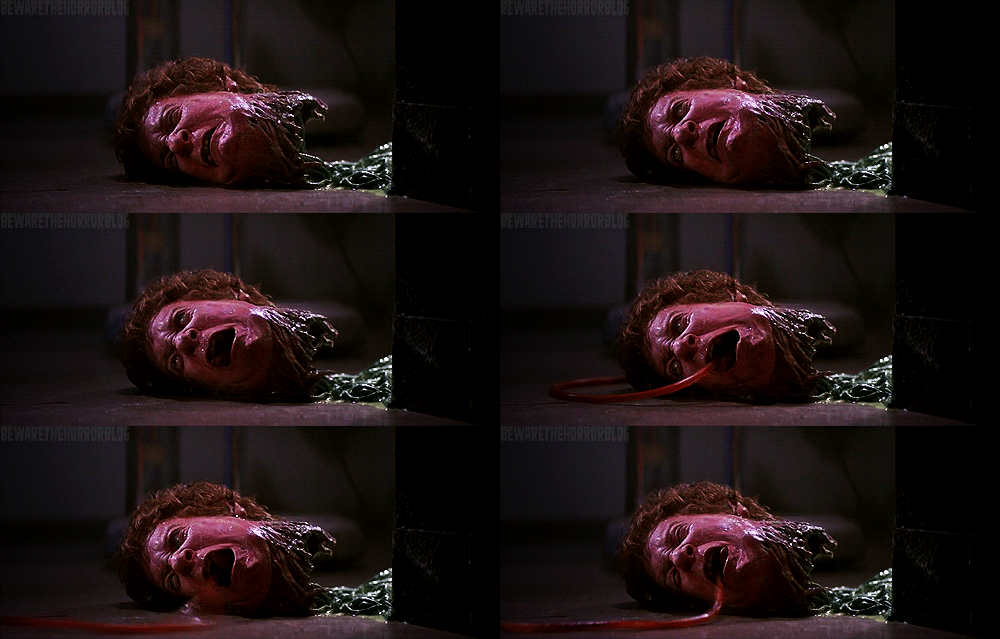
Thing from Another World (Death in Many Forms for OSR)
Had this sitting around for a while. Decided to finish it. Hopefully it is coherent. It's been one of those days. :D
This thing is based off the 1982 John Carpenter film and it's prequel.
It is lethal. PCs should be very well prepared for this.

Thing from Another World
An extraterrestrial parasitic life form capable of assimilating organic organisms. It will perfectly mimic the dominate organic organism and then quietly attempt to assimilate the entire species.
They are an extinction level event waiting to happen. They must be destroyed when found.
AC: 12 (see Size below)
HD: 8 HD base used as a whole or split among it's body parts (see Split ability below)
HP: 48 base used as a whole or 8 per body part HD (see Split ability below)
ATTACKS: (see Size below)
SAVE: by hit dice split
SPECIAL: Absorb, Mimic, Split, Merge, Combat Abilities, Regeneration, Hibernation
MOVE: (see Combat: Movement below)
EXP: Variable

Assimilate
A Thing can perfectly mimic any organic organism. To do so it must assimilate the victim by pressing its flesh directly against the flesh of the victim. The invading flesh must be soft; teeth, hard projectiles, claws, etc cannot initiate the process. A Thing an do this by pressing itself against the target or wrapping tentacles around the target to envelope as much of the victim's flesh as possible. Larger than man-size Things might do this by brute force while a smaller one will most likely use stealth to join its flesh to its target.
Edit, Clarification: When assimilating the Thing has two options: it can absorb the victim and take his place or allow it to stay a separate entity; a new Thing.
A Thing must make an attack roll to hit flesh. If the target is naked, without shirt, etc it is a normal to hit roll. If their flesh is sufficiently covered the face is the almost always preferred target and they must make a called shot with a -6 penalty to hit. If the Thing surprises its victim it gains a +4 to its attack roll, dropping the penalty to -6 for the called shot. Once a Thing has made contact its flesh bonds with the victim's and it must be ripped or burned away causing 2d6 damage to the victim. To rip away the victim must make a Str roll with a -6 penalty. If others help rip the victim away the penalty drops by 2 for each person helping (maximum three helping.)

If a victim is forcefully separated from a Thing he must make a Saving Throw (Poison). If successful he has fought off the invading organism. If failed he will fall into a coma in 1d6 minutes as the assimilate continues from inside. He will be lost as the Thing continues to assimilate and replicate his flesh from the inside out. It will awaken after 1d6x5 minutes and attempt to pass itself of as the victim. Let the player play as normal, don't let him know what has happened. When the Thing emerges it will be as big a shock to them as anyone else.
If the freed victim is somehow flash frozen it may help stop the assimilate process until some sort of healing or medical process can be used to save him.
Each round the victim stays attached to a Thing the victim must make a Saving Throw (Poison) with a cumulative -2 penalty after the first round. Once the Save is failed the victim is paralyzed as the Thing's flesh penetrates into the victim's circulatory and nervous systems . Within 1d6x5 minutes the internal assimilation and mimicry are complete.
The target of assimilation must either be alive or freshly dead: a Thing will not assimilate decaying flesh. It cannot assimilate inorganic material: fillings, prosthesis, surgery pins, etc will be ejected from the mass.
A Thing will generally try to assimilate a victim quietly and in private. It does not want to be interrupted;it prefers stealth tactics to outright violence and it can't replace someone and infiltrate a group if the group knows a person was attacked. If interrupted during this assimilation time it will try to flee. It will have obvious flaws in it's physical form and can be easily identified.

Blatant assimilation is almost always a last ditch defense to save itself when it has no other choice. If it's hand is forced a Thing can merge with other Things (see Merge below) and outright try to destroy its enemies.
Mimicry
Once it has absorbed and replicated and organism a Thing can perfectly mimic that creature.
It activates with full 10HD and abilities. It also gains the replicated creatures natural weapons, movement, special abilities, spells, etc at the level of the creature absorbed. It is indistinguishable from the original creature to all but the most specific tests. It has all of it's memories, mannerisms, habits, etc. Even defects such as a weak heart, weak eyes, scars, etc are replicated.
It must acquire clothing and other equipment to complete its masquerade.
Split
A Thing is a collective organism. Each of its cells can split apart as a separate entity working for the survival of the whole creature. This gives it the ability to split itself off into smaller creatures. This ability is used to save as much of the creature as possible as parts of the collective body become damaged beyond use (such as by fire) or to separate into smaller Things to stealthily hunt down and absorb a victim.
It's ability to split also gives it the ability to grow arms, legs, claws, tentacles, extra heads, eyes, whatever from it's separated body parts. It can split it's flesh to reveal vicious teeth. The combinations are only limited by what a Thing has absorbed in the past. (See Combat: Attacks and Damage below.) The sudden reveal can be a shock to see as the flesh splits and a vicious drooling maw comes a your face. If the Thing is under suspicion it still gets a surprise roll of 1 on a 1d6 to surprise by suddenly splitting open. If it is not under suspicion the chance for surprise goes up to 1-3 on a 1d6.
A Thing mimicking a human has 8 HD, divided into sections for convenience to track abilities, hit points, attack bonuses, saves, etc of smaller forms. When a Thing splits add together the Hit Dice of the new split forms. For example if a head splits off it's a 1 HD creature. The rest of the creature is now 7HD. If the upper torso separates from the pelvis and legs we now have three Things with the following HD: Head Thing - 1HD, Arms and Upper Torso Thing - 4HD, Pelvis and Legs Thing - 3HD.
Each is now a separate entity, an independent Thing seeking to attack and assimilate it's enemies.
If under direct attack or it decides to enter combat a efficiently as possible a Thing will most likely remain at an 8HD pool and use it's greater damage and hp potential to kill or absorb its enemies
Parts Hit Dice:
Head 1 HD (8hp)
Torso 3HD (24hp) [2HD upper torso(16hp) / 1HD (8hp) pelvis if body split apart]
2 Arms 1HD each (8hp each)
2 Legs 1HD each (8hp each)
If hands or feet drop off they are 1/2 HD (4hp) and the arm or let itself becomes 1/2 HD (4hp).
A Thing has maximum hit points per level. It has control over its cellular structure and is built to survive. Unless a called shot is made to an extremity, damage is taken by the torso. Once it is destroyed or in serious threat of permanent damage the Thing will kick into survival mode and it will split its body into smaller Things with 8hp per HD.
Any damage done to specific parts (such as legs on fire) those parts take the damage and it does not affect the other parts. If full body damage is done each part takes the entire damage rolled to its individual hps.
A Thing's intelligence seems to drop with it's smaller sizes. Smaller Things seem to rely more on instinct than on reasoning while larger Things, carrying the experiences of those it has assimilated can be frighteningly intelligent, using technology, even building escape vehicles.
Merge
If threatened with destruction multiple Things can join to increase their mass and fighting ability.
For each man-sized thing merged the base Thing (highest HD) gains 2 HD. The max HD for this is 16 HD. This increases, attacks, damage, and armor class (see combat below.)
Combat
Attacks and Damage
A Thing can split its body open to reveal hidden weaponry: teeth, claws, tentacles, barbs, etc. Nearly anything is possible as long as it was an organic natural weapon previously mimicked. While doing horrific damage these solid weapons cannot initiate an assimilation.
At twice man-size or larger (16HD) it make four attacks per round at 1d12 or one massive attack at 3d10.
At larger than man-size it can make up to three attacks per round at 1d10 or a single attack at 3d8
At man-size it can make up to two attacks per round at 1d8 a single attack at 3d6.
At half man-size (split in half vertically or horizontally) it can make two attacks at 1d6.
At small-size (head, arm, leg, etc.) it can make one attack at 1d4.

Special Attacks
If the DM wishes a Thing can have ranged and other attacks based on what it has assimilated.
One of the easiest ways to do this is simply steal special abilities from other monster stats. I would be careful with this though, only one or two, or it will be overwhelming.
Acid Spray (2d6 per round for 3 rounds). Range of 30'.
Web. As per the spell.
Melee attack at 10' extended range.
If two tentacles hit, draw the victim to the mouth for automatic damage each round until a Saving Throw (Death) at -4 is made.
Armor Class
A Thing takes minimum damage from piercing weapons. Blunt and slashing do half damage. Magical and Heavy Weapons (including explosives) do normal damage.
At twice man-size or larger (16HD) it is AC 16 due to increased size and mass.
At larger than man-size it is AC 14 due to increased size and mass.
At man-size it is AC 12.
At half man-size it's AC 13 due to smaller mass to hit.
At small-size (head, arm, leg, etc.) it is AC 14 due to smaller mass and increased speed.
Movement
While mimicking a creature a Thing uses that creature's natural movement rates until it reveals itself as a Thing.
If necessary it can take a full round action and grow wings, legs, or other ways of moving around quickly. Everything from extra human appendages to insect legs and tentacles based on what it has assimilated in the past.
At twice man-size or larger (16HD): movement drops back to 120(40) as the bulk begins to slow it down.
At larger than man-size: 150(50) it can move faster than a man thanks to multiple legs/appendages and extra muscle.
At man-size and smaller 120(40): even if split apart onto smaller Things the extra legs/appendages allow it to scuttle quickly along.
It is quite likely a Thing has assimilated a creature that can use the spider climb ability, adding to its effectiveness.
Surprise
Smaller Things are master of cover and surprise. If they can get under shelves, tables, chairs, or other cover or down dark hallways with plenty of hidey holes they have a 1-4 on a 1d6 chance of hiding from pursuers. They can sneak along at the same chance. IF they successfully sneak up on a victim they have a chance to surprise them gaining a bonus to their hit; this is especially important when attempting a called shot during an assimilation attempt (see Assimilation above.)

Regeneration
A Thing can regenerate any damage except fire or electricity at 3 hp per round.
Fire and electricity, if applied will cause it to make a Saving Throw (Death). If failed it does not reveal it's nature. If failed it immediately attacks and then attempts to flee once it has cleared a path.
Hibernation
Freezing and below temperatures put a Thing into hibernation.
Use current hit points as a 'hibernation track'. This is how much cold it can take. For each hour in the freezing condition it loses 2d6 from the hp 'track.' When at 0 the creature goes into hibernation. When it is thawed it wakes up in the same condition it was before freezing after 2d6 hours.

This thing is based off the 1982 John Carpenter film and it's prequel.
It is lethal. PCs should be very well prepared for this.
Thing from Another World
An extraterrestrial parasitic life form capable of assimilating organic organisms. It will perfectly mimic the dominate organic organism and then quietly attempt to assimilate the entire species.
They are an extinction level event waiting to happen. They must be destroyed when found.
AC: 12 (see Size below)
HD: 8 HD base used as a whole or split among it's body parts (see Split ability below)
HP: 48 base used as a whole or 8 per body part HD (see Split ability below)
ATTACKS: (see Size below)
SAVE: by hit dice split
SPECIAL: Absorb, Mimic, Split, Merge, Combat Abilities, Regeneration, Hibernation
MOVE: (see Combat: Movement below)
EXP: Variable
Assimilate
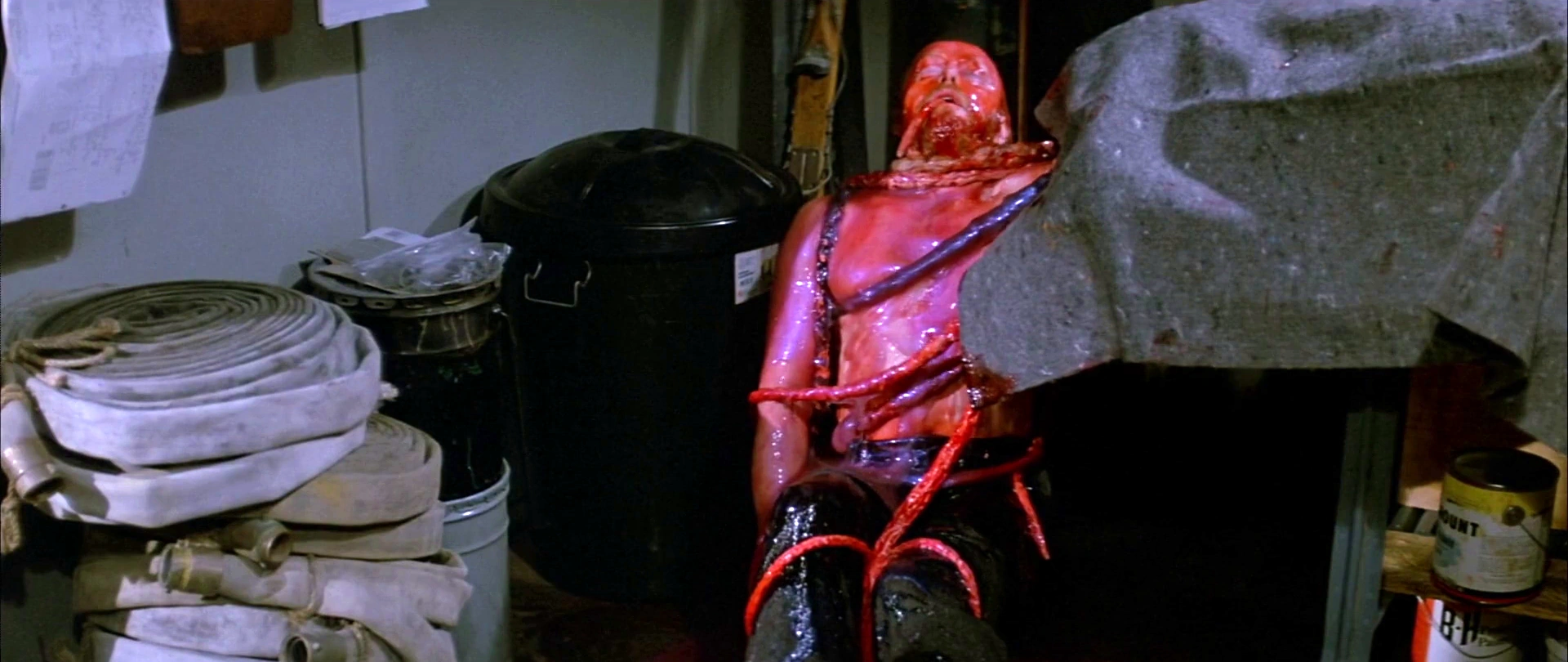
A Thing can perfectly mimic any organic organism. To do so it must assimilate the victim by pressing its flesh directly against the flesh of the victim. The invading flesh must be soft; teeth, hard projectiles, claws, etc cannot initiate the process. A Thing an do this by pressing itself against the target or wrapping tentacles around the target to envelope as much of the victim's flesh as possible. Larger than man-size Things might do this by brute force while a smaller one will most likely use stealth to join its flesh to its target.
Edit, Clarification: When assimilating the Thing has two options: it can absorb the victim and take his place or allow it to stay a separate entity; a new Thing.
A Thing must make an attack roll to hit flesh. If the target is naked, without shirt, etc it is a normal to hit roll. If their flesh is sufficiently covered the face is the almost always preferred target and they must make a called shot with a -6 penalty to hit. If the Thing surprises its victim it gains a +4 to its attack roll, dropping the penalty to -6 for the called shot. Once a Thing has made contact its flesh bonds with the victim's and it must be ripped or burned away causing 2d6 damage to the victim. To rip away the victim must make a Str roll with a -6 penalty. If others help rip the victim away the penalty drops by 2 for each person helping (maximum three helping.)
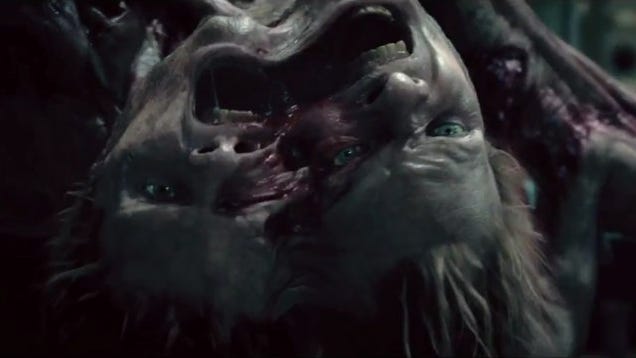
If a victim is forcefully separated from a Thing he must make a Saving Throw (Poison). If successful he has fought off the invading organism. If failed he will fall into a coma in 1d6 minutes as the assimilate continues from inside. He will be lost as the Thing continues to assimilate and replicate his flesh from the inside out. It will awaken after 1d6x5 minutes and attempt to pass itself of as the victim. Let the player play as normal, don't let him know what has happened. When the Thing emerges it will be as big a shock to them as anyone else.
If the freed victim is somehow flash frozen it may help stop the assimilate process until some sort of healing or medical process can be used to save him.
Each round the victim stays attached to a Thing the victim must make a Saving Throw (Poison) with a cumulative -2 penalty after the first round. Once the Save is failed the victim is paralyzed as the Thing's flesh penetrates into the victim's circulatory and nervous systems . Within 1d6x5 minutes the internal assimilation and mimicry are complete.
The target of assimilation must either be alive or freshly dead: a Thing will not assimilate decaying flesh. It cannot assimilate inorganic material: fillings, prosthesis, surgery pins, etc will be ejected from the mass.
A Thing will generally try to assimilate a victim quietly and in private. It does not want to be interrupted;it prefers stealth tactics to outright violence and it can't replace someone and infiltrate a group if the group knows a person was attacked. If interrupted during this assimilation time it will try to flee. It will have obvious flaws in it's physical form and can be easily identified.
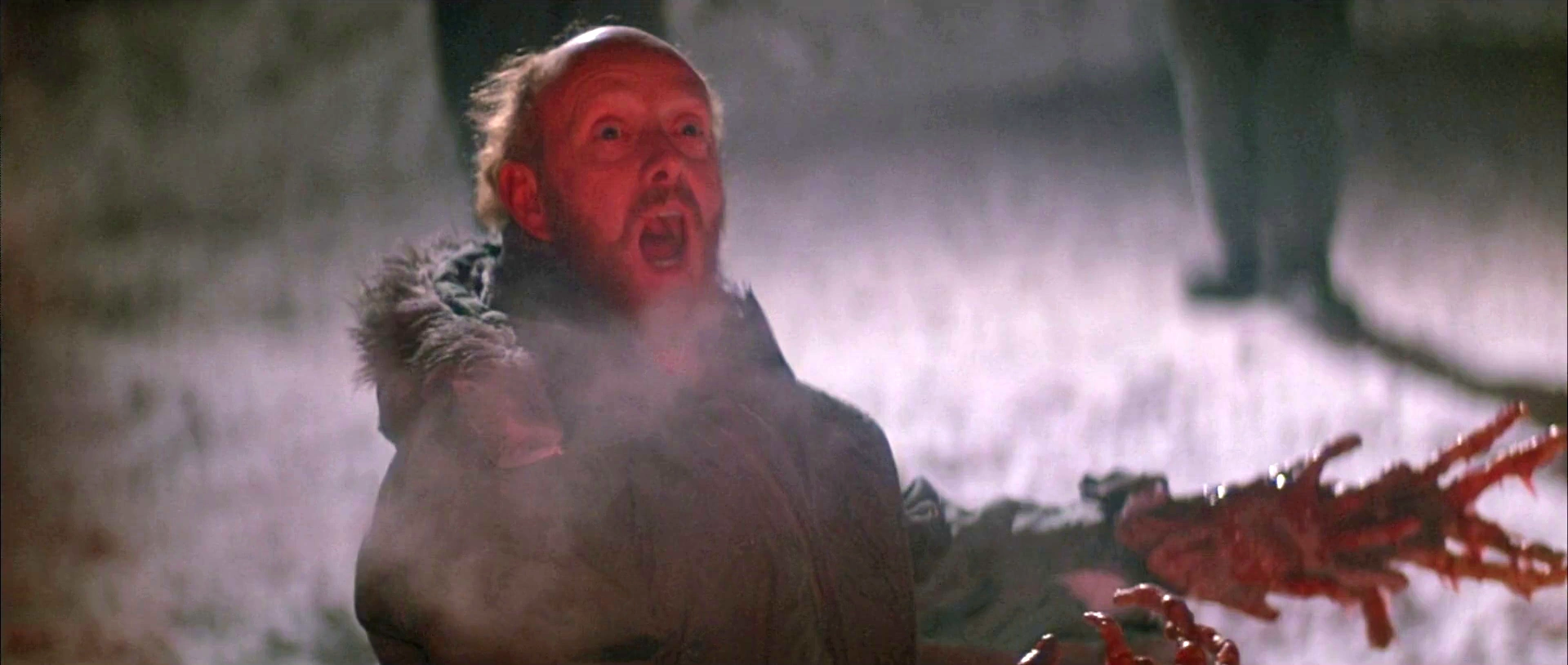
Blatant assimilation is almost always a last ditch defense to save itself when it has no other choice. If it's hand is forced a Thing can merge with other Things (see Merge below) and outright try to destroy its enemies.
Mimicry
Once it has absorbed and replicated and organism a Thing can perfectly mimic that creature.
It activates with full 10HD and abilities. It also gains the replicated creatures natural weapons, movement, special abilities, spells, etc at the level of the creature absorbed. It is indistinguishable from the original creature to all but the most specific tests. It has all of it's memories, mannerisms, habits, etc. Even defects such as a weak heart, weak eyes, scars, etc are replicated.
It must acquire clothing and other equipment to complete its masquerade.
A Thing is a collective organism. Each of its cells can split apart as a separate entity working for the survival of the whole creature. This gives it the ability to split itself off into smaller creatures. This ability is used to save as much of the creature as possible as parts of the collective body become damaged beyond use (such as by fire) or to separate into smaller Things to stealthily hunt down and absorb a victim.
It's ability to split also gives it the ability to grow arms, legs, claws, tentacles, extra heads, eyes, whatever from it's separated body parts. It can split it's flesh to reveal vicious teeth. The combinations are only limited by what a Thing has absorbed in the past. (See Combat: Attacks and Damage below.) The sudden reveal can be a shock to see as the flesh splits and a vicious drooling maw comes a your face. If the Thing is under suspicion it still gets a surprise roll of 1 on a 1d6 to surprise by suddenly splitting open. If it is not under suspicion the chance for surprise goes up to 1-3 on a 1d6.
A Thing mimicking a human has 8 HD, divided into sections for convenience to track abilities, hit points, attack bonuses, saves, etc of smaller forms. When a Thing splits add together the Hit Dice of the new split forms. For example if a head splits off it's a 1 HD creature. The rest of the creature is now 7HD. If the upper torso separates from the pelvis and legs we now have three Things with the following HD: Head Thing - 1HD, Arms and Upper Torso Thing - 4HD, Pelvis and Legs Thing - 3HD.
Each is now a separate entity, an independent Thing seeking to attack and assimilate it's enemies.
If under direct attack or it decides to enter combat a efficiently as possible a Thing will most likely remain at an 8HD pool and use it's greater damage and hp potential to kill or absorb its enemies
Parts Hit Dice:
Head 1 HD (8hp)
Torso 3HD (24hp) [2HD upper torso(16hp) / 1HD (8hp) pelvis if body split apart]
2 Arms 1HD each (8hp each)
2 Legs 1HD each (8hp each)
If hands or feet drop off they are 1/2 HD (4hp) and the arm or let itself becomes 1/2 HD (4hp).
A Thing has maximum hit points per level. It has control over its cellular structure and is built to survive. Unless a called shot is made to an extremity, damage is taken by the torso. Once it is destroyed or in serious threat of permanent damage the Thing will kick into survival mode and it will split its body into smaller Things with 8hp per HD.
Any damage done to specific parts (such as legs on fire) those parts take the damage and it does not affect the other parts. If full body damage is done each part takes the entire damage rolled to its individual hps.
A Thing's intelligence seems to drop with it's smaller sizes. Smaller Things seem to rely more on instinct than on reasoning while larger Things, carrying the experiences of those it has assimilated can be frighteningly intelligent, using technology, even building escape vehicles.
Merge
If threatened with destruction multiple Things can join to increase their mass and fighting ability.
For each man-sized thing merged the base Thing (highest HD) gains 2 HD. The max HD for this is 16 HD. This increases, attacks, damage, and armor class (see combat below.)
Attacks and Damage
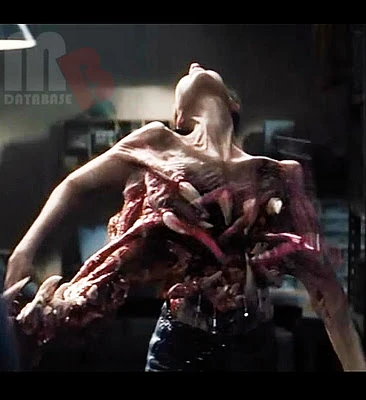
A Thing can split its body open to reveal hidden weaponry: teeth, claws, tentacles, barbs, etc. Nearly anything is possible as long as it was an organic natural weapon previously mimicked. While doing horrific damage these solid weapons cannot initiate an assimilation.
At twice man-size or larger (16HD) it make four attacks per round at 1d12 or one massive attack at 3d10.
At larger than man-size it can make up to three attacks per round at 1d10 or a single attack at 3d8
At man-size it can make up to two attacks per round at 1d8 a single attack at 3d6.
At half man-size (split in half vertically or horizontally) it can make two attacks at 1d6.
At small-size (head, arm, leg, etc.) it can make one attack at 1d4.
Special Attacks
If the DM wishes a Thing can have ranged and other attacks based on what it has assimilated.
One of the easiest ways to do this is simply steal special abilities from other monster stats. I would be careful with this though, only one or two, or it will be overwhelming.
Acid Spray (2d6 per round for 3 rounds). Range of 30'.
Web. As per the spell.
Melee attack at 10' extended range.
If two tentacles hit, draw the victim to the mouth for automatic damage each round until a Saving Throw (Death) at -4 is made.
Armor Class
A Thing takes minimum damage from piercing weapons. Blunt and slashing do half damage. Magical and Heavy Weapons (including explosives) do normal damage.
At twice man-size or larger (16HD) it is AC 16 due to increased size and mass.
At larger than man-size it is AC 14 due to increased size and mass.
At man-size it is AC 12.
At half man-size it's AC 13 due to smaller mass to hit.
At small-size (head, arm, leg, etc.) it is AC 14 due to smaller mass and increased speed.
Movement
While mimicking a creature a Thing uses that creature's natural movement rates until it reveals itself as a Thing.
If necessary it can take a full round action and grow wings, legs, or other ways of moving around quickly. Everything from extra human appendages to insect legs and tentacles based on what it has assimilated in the past.
At twice man-size or larger (16HD): movement drops back to 120(40) as the bulk begins to slow it down.
At larger than man-size: 150(50) it can move faster than a man thanks to multiple legs/appendages and extra muscle.
At man-size and smaller 120(40): even if split apart onto smaller Things the extra legs/appendages allow it to scuttle quickly along.
It is quite likely a Thing has assimilated a creature that can use the spider climb ability, adding to its effectiveness.
Surprise
Smaller Things are master of cover and surprise. If they can get under shelves, tables, chairs, or other cover or down dark hallways with plenty of hidey holes they have a 1-4 on a 1d6 chance of hiding from pursuers. They can sneak along at the same chance. IF they successfully sneak up on a victim they have a chance to surprise them gaining a bonus to their hit; this is especially important when attempting a called shot during an assimilation attempt (see Assimilation above.)

Regeneration
A Thing can regenerate any damage except fire or electricity at 3 hp per round.
Fire and electricity, if applied will cause it to make a Saving Throw (Death). If failed it does not reveal it's nature. If failed it immediately attacks and then attempts to flee once it has cleared a path.
Hibernation
Freezing and below temperatures put a Thing into hibernation.
Use current hit points as a 'hibernation track'. This is how much cold it can take. For each hour in the freezing condition it loses 2d6 from the hp 'track.' When at 0 the creature goes into hibernation. When it is thawed it wakes up in the same condition it was before freezing after 2d6 hours.
Tuesday, January 27, 2015
Fear and Madness Rules (incuding rules for treatment) OSR
Like every other tinker-DM I am compelled to come up with my own rules to tailor to my game-style and genres.
Here is my take on Fear and Madness rules for my Mythos & Madness campaign.
As always (hopefully) I've kept this 'simple' but useful within existing rules mechanics.
Here we go.

FEAR
When the Investigator PC discovers something that the DM feels may cause fear, revulsion, or terror, a realization of their imminent mortality and a challenge to their inherit sense of safety, he may call for a Fear check.
A Fear check is a Saving Throw (Paralysis). If successful the Investigator pushes on with no penalties.

MADNESS
When confronted by a Mythos being or knowledge gained into the true nature of the universe via tomes, spells, etc the DM will often call for a Saving Throw (Paralysis) or the victim sanity slips. Often this Save will be modified by a penalty if the Thing or Knowledge is particularly alien or horrifying.
If the Saving Throw is failed the Investigator becomes terrified and rolls on the Fear table above.
If failed by 10 or more (or a natural 1 rolled) the victim goes mad and gains one of the following afflictions as chosen by the DM (or he creates one of his own.)
1. Addict
2. Compulsion
3. Dark Personality
4. Delusional
5. Depression
6. Insane Quirk
7. Maniac
8. Mutilator
9. Night Terrors
10. Phobia
11. Twitchy
12. Voices
Addict
You self medicate yourself in order to deal with daily existence. To get through the day you must have at least a bottle of drink or a hit of drugs to keep yourself going. If you do not have your daily fix all actions are at -2. When you do have your 'medication' you are only at a -1 penalty.
Compulsion
You must do certain things each day. Compulsions can include such things as having to wash your hands, check your weapons, etc. The DM can call for these randomly (at least one per play session) and you must make a Saving Throw (Paralysis) to avoid doing your little ritual. If you must do it immediately or take a -2 penalty to actions until the ritual is completed. If you fail by 10 or more (or roll a natural 1) you are so distracted by your compulsion you take a -4 to actions until the ritual is fulfilled.
Kleptomania falls under compulsion but works differently. If you fail your Saving Throw you must acquire the object of your desire. You will be at a -2 to actions until you steal it. If you fail by 10 or more (or roll a natural 1) you must have it NOW and will take it despite any consequences.
Particularly dark DM's can come up with more sinister compulsions such as cannibalism or necrophilia.
Such particularly debilitating compulsions may call for a weekly roll instead of a daily roll given the severe social and legal consequences associated with such behavior.
Dark Personality
When under stress you must make a Saving Throw (Paralysis) or a darker piece of your psyche emerges. You are more aggressive and every time you are irritated or challenged you must make a Saving Throw (Paralysis) or become violent towards the object of your irritation. This lasts for 2d6+4 rounds. Once it ends you come to your senses, even if still in a fight. You will not manifest this again for 1d6 hours. You gain a +1 bonus to melee/unarmed damage while in this state.
Delusional
You believe things that are odd and, frankly, not real. Hallucinations are not uncommon. The DM will describe these things as if they are fact to your character. If challenged to the reality of what you believe you must make a Saving Throw (Paralysis). If you fail you refuse to believe what you are told and cling to your reality. If you fail by 5 or more you will be become irrational and refuse to listen. If you fail by 10 or more (or roll a natural 1) you will become physically violent for 2d6+4 rounds.
Depression
You are consumed with severe depression. Every day is a struggle to care enough to get yourself together and face the world. All actions are at a -2. If you are prescribed medication this drops to a -1.
Insane Quirk
You have personality quirks. Severe ones. It can get so bad people become agitated by your presence. You may be paranoid, talk to yourself, wildly laugh inappropriately, constantly fidget, eat odd substances, mimic those around you, or other socially inappropriate behaviors. You may be afflicted with tics, stutters, strange gesturing, tremors, etc. You receive a -2 to Charisma for your quirk. You must make a Saving Throw (Paralysis) each morning. If you fail your particular quirk is particularly bad today increasing your Charisma penalty to -4 for the day.
Maniac
Your madness builds into a murderous rage. If provoked or if you become angry you must make a Saving Throw (Paralysis) or fly into a rage and attack the source of your anger. This rage will last for 1d6 rounds.
If you fail the save by 10 or more (or roll a natural 1) you will fly into a murderous maniacal rage with a +2 bonus to melee/unarmed damage until the target is dead or you are restrained.
Mutilator
You cut, beat, or burn yourself. When you are stressed you must make a Saving Throw (Paralysis) or be overwhelmed. To calm yourself you damage yourself doing superficial damage. However if you fail the save by 10 or more (or roll a natural 1) you go overboard and do 1d3 points of damage.
Night Terrors
There is no rest when you dream. You have vivid nightmares and wake up sweating and screaming. Each night make a Saving Throw (Paralysis). If you fail you are at -1 actions for the rest of the day. If you fail the save by 10 or more (or roll a natural 1) they were exceptionally bad and the penalty is -2.
Phobia
You have an irrational fear of an object or situation. The DM will choose an appropriate one. When faced with the source of your fear you must make a Saving Throw (Paralysis). If you fail you take a -2 penalty to actions while in the presence of the fear. If you fail by 10 or more (or roll a natural 1) you are paralyzed, unable to act until the source of fear is removed.
Twitchy
Your are a nervous wreck. Your nerves are shot and your defenses against Fear and Madness are low. You take a -4 penalty to Saving Throws involving Fear and Madness.
You also receive a + 1 bonus to initiative from being so high strung,
Voices
You hear voices telling you things, arguing with you, taunting, or just giving bad advice. You suffer a -2 to Charisma. You must make a Saving Throw (Paralysis) each morning. If you fail they are exceptionally loud and annoying today and you can't help but talk back to them, increasing your Charisma penalty to -4 for the day. If you fail by 10 or more (or roll a natural 1) you are constantly distracted by them and take a -2 penalty to actions.

Insane Insight
When a character goes insane the DM may allow for the character to gain and reveal a small bit of knowledge he gains about the situation or creature which caused his madness. If the DM calls for it a Wisdom check is rolled. If successful a small bit of information is babbled by the poor mad devil. The DM can use this to provide a vital clue to whatever the Investigator's are dealing with.
Treatment
Medications
Investigators afflicted with madness may not always be taken to a care facility for treatment.
If kept out of such places their afflictions can be lessened with medications. The medications give bonuses to Saving Throws associated with Madness afflictions based on the strength of the medication prescribed. They must be taken daily. If they are skipped they then the patient receives no benefit that day.
Moderate Medication, +2 bonus to Saving Throw
Heavy Medication, +4 bonus to Saving Throw (-1 penalty to Int and Wis)
Recovery
Recovering from an affliction requires a lot of therapy, quite likely medications, and a calm environment for the patient. For each month of treatment the character will get to make a Saving Throw (Paralysis) modified by such things as care environment and drug treatments.
⦁ If the patient makes his Save he is cured of his madness and the affliction is no longer applied.
⦁ If the patient fails the roll he is not cured. He can attempt another Saving Throw the next month as long as the recovery program is followed. If treatment is not given or refused he does not get a Saving Throw for that month.
⦁ If the patient failed by 5 or more the next month's Saving Throw has a -2 penalty.
⦁ If the patient failed by 10 or more (or rolled a natural 1) the next month's Saving Throw has a -4 penalty.
Private Care
This is the absolute best option for a quick recovery. Working in the patient's home or private institution the care-givers can give the patient their complete attention and private caregivers tend to be more compassionate and considerate. This is the best level of care and it is expensive.

Institutionalization
This means being confined to an asylum. The only advantage is that they are cheap or even free if run by the state. Asylum quality varies wildly. Some are run well using the latest methods in therapy; others are absolute Hell-holes that are little better than prisons where the mentally ill are treated as animals. Caregivers, especially in the poorer Institutions are often overworked, underpaid, and very under-qualified for their jobs.
If the patient fails their monthly Saving Throw by 5 or more he must roll immediately roll another at a -4 penalty. Failure at this second Save indicates that he is deteriorating physically and mentally. Healing hit points takes twice as long and the next months Saving Throw is at a further -2 penalty.
Psychotherapy is rare here. The typical treatments involve supervised work, hydrotherapy, electro-shock, confinement, and heavy doses of behavioral medications.
Modifiers to the Monthly Recovery Saving Throw
Psychoanalysis available, +2
Medication, +2 to +4 depending on strength of medication
Private Care environment, +4
Asylum Care environment, 0 to -4 depending on quality of care
Physically and mentally deteriorated, -2
Previous month's Saving Throw failed by 5 or more, -2
Previous month's Saving Throw failed by 10 or more, -4
Refused or denied treatment that month, No Saving Throw allowed
Adventuring that month, No Saving Throw allowed

Here is my take on Fear and Madness rules for my Mythos & Madness campaign.
As always (hopefully) I've kept this 'simple' but useful within existing rules mechanics.
Here we go.
FEAR
When the Investigator PC discovers something that the DM feels may cause fear, revulsion, or terror, a realization of their imminent mortality and a challenge to their inherit sense of safety, he may call for a Fear check.
A Fear check is a Saving Throw (Paralysis). If successful the Investigator pushes on with no penalties.
- Save (Paralysis) or the victim is shaken and receives a -2 to all actions for 1d6 rounds.
- If failed by 5 or more the victim is badly shaken and suffers a -4 to all actions for 1d6 rounds.
- If failed by 10 or more (or a natural 1 rolled) the victim is terrified beyond reason and roll 1d6 for a result below:
1. Fight: You are hit with an adrenal surge and attack the source of terror. You gain a +2 bonus to hit for your frenzy but a -2 penalty to your AC. You will viciously attack the source of terror for 1d6 rounds. Then you may act normally.
2. Sickened: You reel, gagging with revulsion. -4 to all actions for the next 1d4+2 rounds as you struggle to regain control.
3. Shock: You are dazed by the terror. You lose any actions for the next 1d4 rounds. If you recover and the source of terror is still there you suffer a -4 to all actions until the source of terror is defeated, flees, or you can escape yourself.
4. Panic: You begin attacking wildly in a blind panicked frenzy. This lasts for 1d4+2 rounds. Melee or ranged it doesn't matter: randomly determine who you are attacking and gain a +2 bonus to hit for your frenzy but a -2 penalty to your AC. For automatic fire determine a new target for each burst.
5. Blackout: You drop in a dead faint for 1d4+2 rounds. If you awaken and the source of terror is still there you suffer a -2 to all actions until the source of terror is defeated, flees, or you can escape yourself. A character can be awoken from the blackout by an ally with a successful Intelligence check. A Physician adds a +2 bonus to the check, a Scholar with Psychology receives a +4 bonus.
6. Flight: You head away from the source of your terror as fast as you can. This lasts for 1d4 rounds. Make a Save (Paralysis) or drop whatever you are holding. If you cannot flee (trapped in a room, no route out) you must face the terror with a penalty of -4 to all actions until the source of terror is defeated, flees, you can escape yourself, or the length of time rolled expires. A character can be brought out of this state by an ally with a successful Charisma check. A Physician adds a +2 bonus to the check, a Scholar with Psychology receives a +4 bonus.
MADNESS
When confronted by a Mythos being or knowledge gained into the true nature of the universe via tomes, spells, etc the DM will often call for a Saving Throw (Paralysis) or the victim sanity slips. Often this Save will be modified by a penalty if the Thing or Knowledge is particularly alien or horrifying.
If the Saving Throw is failed the Investigator becomes terrified and rolls on the Fear table above.
If failed by 10 or more (or a natural 1 rolled) the victim goes mad and gains one of the following afflictions as chosen by the DM (or he creates one of his own.)
1. Addict
2. Compulsion
3. Dark Personality
4. Delusional
5. Depression
6. Insane Quirk
7. Maniac
8. Mutilator
9. Night Terrors
10. Phobia
11. Twitchy
12. Voices
Addict
You self medicate yourself in order to deal with daily existence. To get through the day you must have at least a bottle of drink or a hit of drugs to keep yourself going. If you do not have your daily fix all actions are at -2. When you do have your 'medication' you are only at a -1 penalty.
Compulsion
You must do certain things each day. Compulsions can include such things as having to wash your hands, check your weapons, etc. The DM can call for these randomly (at least one per play session) and you must make a Saving Throw (Paralysis) to avoid doing your little ritual. If you must do it immediately or take a -2 penalty to actions until the ritual is completed. If you fail by 10 or more (or roll a natural 1) you are so distracted by your compulsion you take a -4 to actions until the ritual is fulfilled.
Kleptomania falls under compulsion but works differently. If you fail your Saving Throw you must acquire the object of your desire. You will be at a -2 to actions until you steal it. If you fail by 10 or more (or roll a natural 1) you must have it NOW and will take it despite any consequences.
Particularly dark DM's can come up with more sinister compulsions such as cannibalism or necrophilia.
Such particularly debilitating compulsions may call for a weekly roll instead of a daily roll given the severe social and legal consequences associated with such behavior.
Dark Personality
When under stress you must make a Saving Throw (Paralysis) or a darker piece of your psyche emerges. You are more aggressive and every time you are irritated or challenged you must make a Saving Throw (Paralysis) or become violent towards the object of your irritation. This lasts for 2d6+4 rounds. Once it ends you come to your senses, even if still in a fight. You will not manifest this again for 1d6 hours. You gain a +1 bonus to melee/unarmed damage while in this state.
Delusional
You believe things that are odd and, frankly, not real. Hallucinations are not uncommon. The DM will describe these things as if they are fact to your character. If challenged to the reality of what you believe you must make a Saving Throw (Paralysis). If you fail you refuse to believe what you are told and cling to your reality. If you fail by 5 or more you will be become irrational and refuse to listen. If you fail by 10 or more (or roll a natural 1) you will become physically violent for 2d6+4 rounds.
Depression
You are consumed with severe depression. Every day is a struggle to care enough to get yourself together and face the world. All actions are at a -2. If you are prescribed medication this drops to a -1.
Insane Quirk
You have personality quirks. Severe ones. It can get so bad people become agitated by your presence. You may be paranoid, talk to yourself, wildly laugh inappropriately, constantly fidget, eat odd substances, mimic those around you, or other socially inappropriate behaviors. You may be afflicted with tics, stutters, strange gesturing, tremors, etc. You receive a -2 to Charisma for your quirk. You must make a Saving Throw (Paralysis) each morning. If you fail your particular quirk is particularly bad today increasing your Charisma penalty to -4 for the day.
Maniac
Your madness builds into a murderous rage. If provoked or if you become angry you must make a Saving Throw (Paralysis) or fly into a rage and attack the source of your anger. This rage will last for 1d6 rounds.
If you fail the save by 10 or more (or roll a natural 1) you will fly into a murderous maniacal rage with a +2 bonus to melee/unarmed damage until the target is dead or you are restrained.
Mutilator
You cut, beat, or burn yourself. When you are stressed you must make a Saving Throw (Paralysis) or be overwhelmed. To calm yourself you damage yourself doing superficial damage. However if you fail the save by 10 or more (or roll a natural 1) you go overboard and do 1d3 points of damage.
Night Terrors
There is no rest when you dream. You have vivid nightmares and wake up sweating and screaming. Each night make a Saving Throw (Paralysis). If you fail you are at -1 actions for the rest of the day. If you fail the save by 10 or more (or roll a natural 1) they were exceptionally bad and the penalty is -2.
Phobia
You have an irrational fear of an object or situation. The DM will choose an appropriate one. When faced with the source of your fear you must make a Saving Throw (Paralysis). If you fail you take a -2 penalty to actions while in the presence of the fear. If you fail by 10 or more (or roll a natural 1) you are paralyzed, unable to act until the source of fear is removed.
Twitchy
Your are a nervous wreck. Your nerves are shot and your defenses against Fear and Madness are low. You take a -4 penalty to Saving Throws involving Fear and Madness.
You also receive a + 1 bonus to initiative from being so high strung,
Voices
You hear voices telling you things, arguing with you, taunting, or just giving bad advice. You suffer a -2 to Charisma. You must make a Saving Throw (Paralysis) each morning. If you fail they are exceptionally loud and annoying today and you can't help but talk back to them, increasing your Charisma penalty to -4 for the day. If you fail by 10 or more (or roll a natural 1) you are constantly distracted by them and take a -2 penalty to actions.
Insane Insight
When a character goes insane the DM may allow for the character to gain and reveal a small bit of knowledge he gains about the situation or creature which caused his madness. If the DM calls for it a Wisdom check is rolled. If successful a small bit of information is babbled by the poor mad devil. The DM can use this to provide a vital clue to whatever the Investigator's are dealing with.
Treatment
Medications
Investigators afflicted with madness may not always be taken to a care facility for treatment.
If kept out of such places their afflictions can be lessened with medications. The medications give bonuses to Saving Throws associated with Madness afflictions based on the strength of the medication prescribed. They must be taken daily. If they are skipped they then the patient receives no benefit that day.
Moderate Medication, +2 bonus to Saving Throw
Heavy Medication, +4 bonus to Saving Throw (-1 penalty to Int and Wis)
Recovery
Recovering from an affliction requires a lot of therapy, quite likely medications, and a calm environment for the patient. For each month of treatment the character will get to make a Saving Throw (Paralysis) modified by such things as care environment and drug treatments.
⦁ If the patient makes his Save he is cured of his madness and the affliction is no longer applied.
⦁ If the patient fails the roll he is not cured. He can attempt another Saving Throw the next month as long as the recovery program is followed. If treatment is not given or refused he does not get a Saving Throw for that month.
⦁ If the patient failed by 5 or more the next month's Saving Throw has a -2 penalty.
⦁ If the patient failed by 10 or more (or rolled a natural 1) the next month's Saving Throw has a -4 penalty.
Private Care
This is the absolute best option for a quick recovery. Working in the patient's home or private institution the care-givers can give the patient their complete attention and private caregivers tend to be more compassionate and considerate. This is the best level of care and it is expensive.
Institutionalization
This means being confined to an asylum. The only advantage is that they are cheap or even free if run by the state. Asylum quality varies wildly. Some are run well using the latest methods in therapy; others are absolute Hell-holes that are little better than prisons where the mentally ill are treated as animals. Caregivers, especially in the poorer Institutions are often overworked, underpaid, and very under-qualified for their jobs.
If the patient fails their monthly Saving Throw by 5 or more he must roll immediately roll another at a -4 penalty. Failure at this second Save indicates that he is deteriorating physically and mentally. Healing hit points takes twice as long and the next months Saving Throw is at a further -2 penalty.
Psychotherapy is rare here. The typical treatments involve supervised work, hydrotherapy, electro-shock, confinement, and heavy doses of behavioral medications.
Modifiers to the Monthly Recovery Saving Throw
Psychoanalysis available, +2
Medication, +2 to +4 depending on strength of medication
Private Care environment, +4
Asylum Care environment, 0 to -4 depending on quality of care
Physically and mentally deteriorated, -2
Previous month's Saving Throw failed by 5 or more, -2
Previous month's Saving Throw failed by 10 or more, -4
Refused or denied treatment that month, No Saving Throw allowed
Adventuring that month, No Saving Throw allowed
Monday, January 26, 2015
The Sea Serpent of Southport, a Mythos and Mayhem Playlog Part One (OSR)
My intro game to my friends for Mythos and Mayhem.
This was a two parter and the first part was earlier this week.
Part I
The PC's are a group of friend's interested in the strange and bizarre.
A Jr. Professor of Anthropology at Miskatonic (Scholar), a private detective in Arkham (Detective), and a WWI vet (Soldier) and his faithful dog.
An old friend of the Professor's, a Dr in the small town of Southport two days north of Arkham invited them to investigate strange sightings and five deaths in the town.
The newspapers carried a small article (before the authorities got it suppressed) of the sighting of a 'sea serpent' off the docks of Southport. No mention of deaths was reported (they were poor hobo fishermen living in shanties.)

The PC's show up, meet up with the Doctor and the Sheriff (who isn't happy about outsiders) and proceed to investigate after taking lodging at the local boarding house called the Inne,.
In town they meet:


This was a two parter and the first part was earlier this week.
Part I
The PC's are a group of friend's interested in the strange and bizarre.
A Jr. Professor of Anthropology at Miskatonic (Scholar), a private detective in Arkham (Detective), and a WWI vet (Soldier) and his faithful dog.
An old friend of the Professor's, a Dr in the small town of Southport two days north of Arkham invited them to investigate strange sightings and five deaths in the town.
The newspapers carried a small article (before the authorities got it suppressed) of the sighting of a 'sea serpent' off the docks of Southport. No mention of deaths was reported (they were poor hobo fishermen living in shanties.)
The PC's show up, meet up with the Doctor and the Sheriff (who isn't happy about outsiders) and proceed to investigate after taking lodging at the local boarding house called the Inne,.
In town they meet:
- The hostile Sheriff who hates snoops and is trying to keep things quiet before feds and other problems show up. He is invested in an 'open' speakeasy fishing tavern on the docks he lets stay open despite Prohibition and skims profits.
- Deputy Dickie, an idiot who gets to guard the hobo corpses in the ice house.
- A nosy reporter who gets suppressed ALOT,
- Angry fishermen who think it's all a hoax by 'big fishin' comp'ny's ta drive us outta our fishin grounds....SPIT.'
- A creepy spooked old man who haunts the tavern restlessly watching as if he's being hunted.
- A big game hunter who has shown up hoping the serpent is real.
- Hell even a fake sideshow gypsy woman trying to read some palms for cash.
They head to the ice house and investigate the hobo fishermen corpses after getting past Deputy Dickie.
The corpses all exhibit large bite marks and tears. Shark-like.
Two of the corpses look odd. They have a bulgy eyed look and wide mouths with deep creases in their necks.
All are covered with a fishy smelling foul slime.
A partial webbed hand print is found on the ice house slab.
The Nosy Reporter bribes Dickie and heads in taking big flash-bulb pics pissing the PC's off. The Soldier destroys the photo plates and they shoo him out before leaving.
They then almost get into it with the angry drunk fishermen at the tavern but appease them with beer and promises. They learn of supposed 'watchers in black robes' sighted about town near the cemetery, the docks, and out by the old swamp.
The fishermen think it's another big fish company trick.
Before they leave they see a spooked Old Man come in and sit to drink by the drunk fishermen. He's twitchy, like a hunted animal. Not wanting to roust a local in front of the agitated fishermen they move on,
After dark the PC's promptly split up and the Professor heads to the swamps, the Soldier to the cemetery, and the Detective scopes out the docks.
The Professor heads east of town, into the woods on the edge of the swamp and soon realizes someone is following him.
Drawing a knife he takes cover behind a tree and a black robed figure passes by. The Professor quickly jumps on the figure's back and puts a knife to his throat.
Interrogating the figure its hood falls back showing a hick with the same fishy look as the hobo corpses, barefoot and with tattered overalls. A swamp hillbilly.
The Hick tries to talk his way out of trouble in broken swamp English when the Professor hears another one sneaking up behind. Realizing the first Hick is drawing a knife from his belt the Professor cuts his throat (taking him from 15 to 5 hit points; I allowed the backstab to stand as the Hick was at mercy. Great damage rolls.)
Clutching his bleeding throat the Hick cries out "Tull, help I'm dyin' !" and stumble into the swamp water.
Tull throws off his robe to show another fishy Hillbilly, draws a strange knife and thus begins several insane rounds of knife fighting with the non-combat orientated Professor barely getting nicked and killed the hulking Tull with several deep stabs before burying the knife up under his ribs into his heart.
The first Hick has escaped into the swamps.
Meanwhile, on the north edge of town at the cemetery the Soldier, crouched by a nearby house, watches the church priest come out with a lantern, check around, then lock himself into the church for the night. Lights go out.
The Soldier then advances and hops the iron fence as a light fog comes up.
His dog refuses to go in, whimpering in fear.
Creeping among the headstones in the light fog he sees a robed figure lurking about as well.
Sneaking up close he draws his .45 semi-auto pistol.
The figure hears him however and turns exposing it's face: a hideous pale and green fish/frog face with needle like teeth!
The Soldier is startled and fires a booming shot, hitting the Deep One in the shoulder.
It ducks away and loses the Soldier in the fog and headstones.
Lights come on as sleepers awaken and people, already scared, come out armed with lanterns and wait for the Sheriff in the streets.
Warned to not cause problems the Soldier beats feet and takes the long way around town towards the south where the tavern is by the docks.
To the west of town the Detective heads to the shanty shacks of the hobo fishermen by the river which spills into the bay. He gets a bit of info from them and views the smashed shanties where the five were killed. He learns one of the shanties belonged to the Old Man in the tavern, Paying the hobos a bit of cash he heads back to the docks.
At the docks the Detective leans up against the tavern wall in the shadows, watching and listening, while smoking a cigarette.
He notices a few odd ripples in the bay as if something big is moving.
Then the .45 shot booms all over town and everyone comes out of the tavern and homes making a ruckus,.
We ended part one there.
Sunday, January 25, 2015
Mythos & Mayhem. Working on a few Mythos spell conversions. (OSR)
I'm working up a few of the classic Chaosium spells for our game.
I'm referencing CoC and CoC d20 for inspiration.
Got three worked up the last half hour and decided what the Hell let's post them.

Chant of Thoth
Spell Level: 3
Duration: 1 round per level
Range: Self
Adds a +5/25% to all checks, attribute and class ability, involving Intelligence.
Voice of Ra
Spell Level: 4
Duration: 24 hours.
Range: Self
This spell adds 1d6+4 (Max 18) to the caster’s Charisma.
This is also used as a bonus number of HD in calculating creatures affected by Charm spells.
Voorish Sign
Spell Level: None
Duration: Immediate
Range: Self
This is not a spell but a complex hand gesture to enhance spell use. Once the gesture is discovered or a teacher found the would-be user must make an Int check and a Dex check to learn it. Once it is learned it can be used at will unless the caster is under duress such as an attack, restrained, etc. In such a situation the caster must make a Dex check to successfully employ it. Using the Voorish Sign is a full round action.
It must be used immediately after being cast on a new spell.
For Non-Spellcasters: The Sign gives a +4 bonus to Casting Check of the next spell.
For Spellcasters: The Sign gives a +4 bonus to the Casting Check for rituals. For normal 'slot' spellcasting the spell cast by the spellcaster in the next round is treated as if it the spellcaster was two levels higher.

I'm referencing CoC and CoC d20 for inspiration.
Got three worked up the last half hour and decided what the Hell let's post them.

Chant of Thoth
Spell Level: 3
Duration: 1 round per level
Range: Self
Adds a +5/25% to all checks, attribute and class ability, involving Intelligence.
Voice of Ra
Spell Level: 4
Duration: 24 hours.
Range: Self
This spell adds 1d6+4 (Max 18) to the caster’s Charisma.
This is also used as a bonus number of HD in calculating creatures affected by Charm spells.
Voorish Sign
Spell Level: None
Duration: Immediate
Range: Self
This is not a spell but a complex hand gesture to enhance spell use. Once the gesture is discovered or a teacher found the would-be user must make an Int check and a Dex check to learn it. Once it is learned it can be used at will unless the caster is under duress such as an attack, restrained, etc. In such a situation the caster must make a Dex check to successfully employ it. Using the Voorish Sign is a full round action.
It must be used immediately after being cast on a new spell.
For Non-Spellcasters: The Sign gives a +4 bonus to Casting Check of the next spell.
For Spellcasters: The Sign gives a +4 bonus to the Casting Check for rituals. For normal 'slot' spellcasting the spell cast by the spellcaster in the next round is treated as if it the spellcaster was two levels higher.
The Cop. A new Class for Mythos and Mayhem (OSR)
I wanted a class for player's to play a cop, police inspector, G-Man, etc. To have abilities tied to their authority and kick some ass. I also wanted to distinguish police inspectors from the Sherlock Holmes inspired Detective class.

The Cop
Officers of the Law. From the simple patrol Cop to Inspectors to Federal Agents your job is the same: catch the bad guys and lock them away with hard evidence and determination. You are skilled at interrogation and information gathering and can hold your own in a fight.
Hit Die Type 1d6+2
Save As Fighting-man
Hit +1 per level
Prime Attribute (5% xp bonus) Cha 13+
You may be a simple beat Cop, a Police Detective or even FBI, but
Class Abilities
Badge
The Cop has authority and can use it. He can arrest anyone who has committed a crime or who he suspects of committing a crime and, with due process, hold them for trial. Once per day per level, he can attempt to use his authority to intimidate one person. If the victim fails a Saving Throw, he will obey the order given by the Cop, be it drop his gun, come with the Cop, etc. The victim will never do anything irrational, such as shooting himself or his friends. There is a cumulative penalty of -1 to the Saving Throw for every three levels of Cop.
Official Channels
Through informants and official channels, the Cop is often in the know on important information, both locally and abroad. Such pertinent information may include who a shady looking guy on the street may be, who’s the local fence, or if the tough guy who just walked into the bar is a wanted felon. With a successful Charisma check the Cop may ask one favor of a contact such as a favor from a city official, a friendly crook to check on some information, etc. The favor will be things not generally available to the average policeman. The contact will not endanger himself or his employment and may negotiate a payment or favor in return if the request by the Cop is difficult or unpleasant.
Steely Gaze
The Cop can intimidate a number of creatures with HD equal to his level. The creatures must be able to see the Cop stare to be affected. The creatures are allowed a Saving Throw to avoid this effect The creatures are allowed a Saving Throw to avoid this effect with a cumulative penalty of -1 for every three levels of Cop. . Those that fail suffer a –2 to all attacks on the Cop. Many will flee; only the most determined will stay and fight. This ability can be used 1 per day per 2 levels of the Cop.
EDIT: One of my player's played this one tonight as a Treasury Agent after his primary character got shredded by a mutant sea serpent summoned by a group of Deep Ones and Hillbilly Hybrids.
I knew something was missing but I couldn't decide what. The class needs a tweak, a couple of abilities to make it more fun and archetypal of the bootleg busting Fed of the twenties.
Then it hit me. It seems like they should be sneaky fellows breaking in for the bust. It seemed like a lot of the cops in films knew how to pick lock as part of their pre-police skillset or picked it up by necessity.
And so: Stopping just after character creation I added Pick Locks and Hear Noise to round it out.
It feels more satisfying and the player seemed to enjoy the added abilities.
Hear Noise
The Cop has honed his senses to here noise others might miss. This is an invaluable skill when raiding a hideout or listening for information in a smokey bar, etc. His chance to hear noise is 3 in 6 at first level increasting to 4 in 6 at 3rd level, 5 in 6 at 7th level, and 6 in 6 at 10th level. To use this ability he must stop all activity and concentrate.
Open Locks
Sometimes the Cop has to get in places he shouldn't be. Some locks are diffucult and may require a penalty to the open roll. The base chance for success is modified by a Dex bonus. Superior tools may grant a small bonus just as inferior tools may incur a small penalty.
.

The Cop
Officers of the Law. From the simple patrol Cop to Inspectors to Federal Agents your job is the same: catch the bad guys and lock them away with hard evidence and determination. You are skilled at interrogation and information gathering and can hold your own in a fight.
Hit Die Type 1d6+2
Save As Fighting-man
Hit +1 per level
Prime Attribute (5% xp bonus) Cha 13+
You may be a simple beat Cop, a Police Detective or even FBI, but
Class Abilities
Badge
The Cop has authority and can use it. He can arrest anyone who has committed a crime or who he suspects of committing a crime and, with due process, hold them for trial. Once per day per level, he can attempt to use his authority to intimidate one person. If the victim fails a Saving Throw, he will obey the order given by the Cop, be it drop his gun, come with the Cop, etc. The victim will never do anything irrational, such as shooting himself or his friends. There is a cumulative penalty of -1 to the Saving Throw for every three levels of Cop.
Official Channels
Through informants and official channels, the Cop is often in the know on important information, both locally and abroad. Such pertinent information may include who a shady looking guy on the street may be, who’s the local fence, or if the tough guy who just walked into the bar is a wanted felon. With a successful Charisma check the Cop may ask one favor of a contact such as a favor from a city official, a friendly crook to check on some information, etc. The favor will be things not generally available to the average policeman. The contact will not endanger himself or his employment and may negotiate a payment or favor in return if the request by the Cop is difficult or unpleasant.
Steely Gaze
The Cop can intimidate a number of creatures with HD equal to his level. The creatures must be able to see the Cop stare to be affected. The creatures are allowed a Saving Throw to avoid this effect The creatures are allowed a Saving Throw to avoid this effect with a cumulative penalty of -1 for every three levels of Cop. . Those that fail suffer a –2 to all attacks on the Cop. Many will flee; only the most determined will stay and fight. This ability can be used 1 per day per 2 levels of the Cop.
EDIT: One of my player's played this one tonight as a Treasury Agent after his primary character got shredded by a mutant sea serpent summoned by a group of Deep Ones and Hillbilly Hybrids.
I knew something was missing but I couldn't decide what. The class needs a tweak, a couple of abilities to make it more fun and archetypal of the bootleg busting Fed of the twenties.
Then it hit me. It seems like they should be sneaky fellows breaking in for the bust. It seemed like a lot of the cops in films knew how to pick lock as part of their pre-police skillset or picked it up by necessity.
And so: Stopping just after character creation I added Pick Locks and Hear Noise to round it out.
It feels more satisfying and the player seemed to enjoy the added abilities.
Hear Noise
The Cop has honed his senses to here noise others might miss. This is an invaluable skill when raiding a hideout or listening for information in a smokey bar, etc. His chance to hear noise is 3 in 6 at first level increasting to 4 in 6 at 3rd level, 5 in 6 at 7th level, and 6 in 6 at 10th level. To use this ability he must stop all activity and concentrate.
Open Locks
Sometimes the Cop has to get in places he shouldn't be. Some locks are diffucult and may require a penalty to the open roll. The base chance for success is modified by a Dex bonus. Superior tools may grant a small bonus just as inferior tools may incur a small penalty.
Saturday, January 24, 2015
OSR Vehicle Rules (My take on them)
I already posted very basic ones here.
I wanted more in depth rules, but not overwhelming.
So I hashed this out. Influences included existing Vehicle Rules from the Polyhedron Mini-Game Thunderball Rally and home-brew Mutant Future Vehicle Rules from John Wilson.

Here we go.
DRIVING CHECKS
The Drive Check is simply a normal Dex roll modified by road conditions, damage, and perhaps even a Class Ability.(Driver Class) All penalties and bonuses are cumulative.
CONSEQUENCES OF FAILING A DRIVE CHECK
IF the Drive Check is failed by 1-5 on the roll of d20: Skid.
IF the Drive Check is failed by 6-10 on the roll of d20: Spin.
IF the Drive Check is failed by 11+ on the roll of d20: Roll (if the Vehicle is traveling faster than 30 mph, or at DM's discretion.).
Skid
The Vehicle travels in the direction it was heading for a distance of feet equal to 1/2 of the speed it was travelling in mph. The Driver must make a Drive Check at the end of the skid (-2 penalty) or the vehicle comes to an abrupt halt. If the vehicle is travelleling more than 30 mph there is a chance that the Vehicle rolls over if the Check is missed by 11+.
If the Vehicle hits an object both take damage as per normal collision rules. Passengers take half of all damage. (See Vehicle and Passenger Damage below.)
Spin
The Vehicle spins wildly for the roud and ends up facing a random (1d8) direction. If the Driver makes a successful Drive Check (-8 penalty) the Vehicle can continue at normal speed if. If failed it skids to a stop after a distance in feet equal to 1/2 of the speed it was travelling in mph, now facing the new direction. If the vehicle is travelleling more than 30 mph there is a chance that the Vehicle rolls over if the Check is missed by 11+.
If the Vehicle hits an object both take damage as per normal collision rules. Passengers take half of all damage. (See Vehicle and Passenger Damage below.)
Roll
The Vehicle roll in a straight line for a number of feet equal to it's current speed in mph x 1d6.
Damage is equal to normal mph damage plus an extra 2d6 for rolling. If the rolling If he Vehicle hits an object both take damage as per normal collision rules. Passengers take half of all damage, including the extra rolling damage. (See xxxx below,)
50 percent chance of landing wheels on ground.
COMBAT BASICS
Initiative
Standard initiative rolls. The vehicle moves on the driver's initiative.
If the vehicle has a crew (such as gunners) they act on their own initiative, if group initiative is not used..
Vehicle Speed
The speed listed for each vehicle is the functional maximum speed in miles per hour. A Driver can drive safely at half of this speed (round up.) If travelling past this speed and a Drive Check is called for a penalty is incurred based on how fast the Driver is going. If driving between 50 percent and 75 percent max speed the Drive check is at a -2 penalty. If over 75 percent to 100 percent max speed the Drive Check is at -4.
The driver can push the max speed and gain more speed at the cost of control and stress to the vehicle. The max speed can be pushed for an additional 20 mph. Drive Checks at this speed are at a -6 penalty. Every 5 rounds of pushing it requires the Driver to roll a 1d6. On a 1 or 2 the motor is damaged and the Driver must roll a Drive Check at -6 or wreck it. Until fixed the car is at half max speed.
Combat Speed vs Character Movement
Keeping it quick and easy: movement in feet equals 10' per every mph travelling. (ex: 25 mph euals 250 feet per round.)

Vehicle Armor Class
Each Driver adds his Dex bonus to the vehicle's AC. For every 20mph of movement add a +1 to vehicle AC IF the vehicle is travelling across the attacker's path; not going towards or moving away.
Attacking Tires
Automobile Tires: AC: 12, HP: 2 (can be popped with penetrating or slashing weapons) -4 to hit when vehicle moving.
Heavy Truck / Airplane Tires: AC: 12, HP: 4 (can be popped with penetrating or slashing weapons) -4 to hit when vehicle moving.
For each tire blown out the Driver must make a Drive (Dex) check at a -1 penalty per tire or wreck the vehicle. This must be rolled each round until the vehicle stops.
Damaged Vehicles and Driving
A vehicle taken to half hit points is considered so damaged that the Driver has a -2 to all Drive checks. When a vehicle loses all its hit points it stops moving and is out of commission.
PASSENGERS
Vehicle Cover
Enlosed Vehicles give passengers and driver a +6 bonus to AC for cover. Open-Top Vehices give a +4 bonus. Motorcycles and ATV's give a +2.
Targeting Passengers
PC's must state they are aiming at Passengers before their attack.
Hit Passenger AC + Cover bonus + Driver bonuses to Vehicle AC.
Armor Piercing rounds and Heavy Weapons ignore cover unless the Vehicle has Heavy Armor..
Attacks from Vehicles
Attacks on even surfaces such as pavement are at no penalty. Rough terrain such as bumpy roads, fields, or other off-road conditions may incur a -2 or -4 penalty.
Other penalties from the DM may apply as well.
RAMMING/COLLISIONS
To successfully ram a vehicle or other object a Driver must make a Drive Check with a +4 bonus. If successful the vehicle plow into its target. Tanks are good at ramming things, especially smaller vehicles.
If a vehicle is hit the rammed Driver must make a Drive Check or lose control. If the attacking Driver fails and rolls a natural 1 or 2 on the d20 the attacking Driver must make a Drive Check of his own or lose control.
If two vehicles are attempting to ram each other, each Driver makes a normal Drive Check with a +4 bonus. Whomever makes the highest roll has the advantage; the other Driver must make a second Drive Check or wreck his vehicle. If both miss, nobody hit. If it's a tied roll, both take damage and both make Drive Check to see if they lose control.
Damage
Crashing or ramming vehicles take 1d6 points of damage for every ten miles per hour they are travelling. Armored vehicles multiply this damage: x2 for Light armor, x4 for Medium armor, x8 for Heavy armor.
Against unarmored vehicles a Light armored vehicle takes 1/4 damage. For collisions with other armored vehicles damage is reduced the same as if the opposing AV is a weapon of the same rating as its armor. Thus a Heavy armor tank ramming a Light armor tank would take no damage; the light tank would take full damage.
⦁ If a Vehicle rams another from behind subtract the target Vehicle's mph from the ramming Vehicle's mph. The remainder is the damage to both Vehicles and Drive Checks are required as normal. .
⦁ If a Vehicle T-bones another vehicle both take the damage from the ramming vehicle's mph. Unarmored vehicles or armored of the same rating come to a dead stop. Smaller armored vehicles are knocked aside. An armored vehicle will plow over or through a smaller unarmored vehicle.
⦁ If two Vehicles hit head-on add the amount of d6 damage from BOTH Vehicles mph and add them together for damage. Unarmored vehicles or armored of the same rating come to a dead stop. An armored vehicle will plow over or through a smaller unarmored vehicle.
When ramming buildings etc use the following guidelines adjusted for fortifications, etc.
⦁ Hard targets: concrete buildings and barricades rate as Light armor, heavy steel rates as Medium armor.
⦁ Soft Targets: Normal wood and earth rate as no armor or Light armor if thick trees, etc.

Sideswipe/Grazing/Pushing
Grazing a vehicle as a sideswipe does 2d6 damage to each vehicle and none to the Passengers. For armored vehicles follow the same damage guidelines as above. A sideswiped Driver must make a Driving check or lose control.
Pushing another Vehicle off the road or into obstacles is a Ramming Maneuver as above.

PASSENGER DAMAGE
Passengers take half damage from all wrecks and collisions (except for grazing/sideswiping.)
Passenger damage can be reduced by the following:
A seat belt reduces the damage by 25 percent.
Airbags reduces the remaining damage by 25 percent.
A Saving Throw (Death) allows the Passenger to reduce the remaining damage by 50 percent.
Damage reduction is cumulative and follows the order of seat belt, then airbag, then finally Save.
If a Passenger in the Vehicle is brought below 0 hp but has more than -10hp he can make a Saving Throw (Death). IF successful the Passenger is stabilized but unconscious and in critical condition. For each hour they are without medical help they must roll another Saving Throw or die.
If they are at -10 hp or lower or the after wreck Saving Throw is failed the Passenger is dead at the wreck.
VEHICLE CHASE
Short and Sweet: Mark starting positions at beginning of combat.
Use the Vehicle Combat Speed (10' for every mph of speed) to determine distance each round.
Obstacles such as other traffic, pedestrians, barricades, etc are avoided with successful Drive Checks. Failure is handled as failing Drive Checks and Ramming and Damage rules above.

I wanted more in depth rules, but not overwhelming.

So I hashed this out. Influences included existing Vehicle Rules from the Polyhedron Mini-Game Thunderball Rally and home-brew Mutant Future Vehicle Rules from John Wilson.
Here we go.
DRIVING CHECKS
The Drive Check is simply a normal Dex roll modified by road conditions, damage, and perhaps even a Class Ability.(Driver Class) All penalties and bonuses are cumulative.
CONSEQUENCES OF FAILING A DRIVE CHECK
IF the Drive Check is failed by 1-5 on the roll of d20: Skid.
IF the Drive Check is failed by 6-10 on the roll of d20: Spin.
IF the Drive Check is failed by 11+ on the roll of d20: Roll (if the Vehicle is traveling faster than 30 mph, or at DM's discretion.).
Skid
The Vehicle travels in the direction it was heading for a distance of feet equal to 1/2 of the speed it was travelling in mph. The Driver must make a Drive Check at the end of the skid (-2 penalty) or the vehicle comes to an abrupt halt. If the vehicle is travelleling more than 30 mph there is a chance that the Vehicle rolls over if the Check is missed by 11+.
If the Vehicle hits an object both take damage as per normal collision rules. Passengers take half of all damage. (See Vehicle and Passenger Damage below.)
Spin
The Vehicle spins wildly for the roud and ends up facing a random (1d8) direction. If the Driver makes a successful Drive Check (-8 penalty) the Vehicle can continue at normal speed if. If failed it skids to a stop after a distance in feet equal to 1/2 of the speed it was travelling in mph, now facing the new direction. If the vehicle is travelleling more than 30 mph there is a chance that the Vehicle rolls over if the Check is missed by 11+.
If the Vehicle hits an object both take damage as per normal collision rules. Passengers take half of all damage. (See Vehicle and Passenger Damage below.)
Roll
The Vehicle roll in a straight line for a number of feet equal to it's current speed in mph x 1d6.
Damage is equal to normal mph damage plus an extra 2d6 for rolling. If the rolling If he Vehicle hits an object both take damage as per normal collision rules. Passengers take half of all damage, including the extra rolling damage. (See xxxx below,)
50 percent chance of landing wheels on ground.
COMBAT BASICS
Initiative
Standard initiative rolls. The vehicle moves on the driver's initiative.
If the vehicle has a crew (such as gunners) they act on their own initiative, if group initiative is not used..
Vehicle Speed
The speed listed for each vehicle is the functional maximum speed in miles per hour. A Driver can drive safely at half of this speed (round up.) If travelling past this speed and a Drive Check is called for a penalty is incurred based on how fast the Driver is going. If driving between 50 percent and 75 percent max speed the Drive check is at a -2 penalty. If over 75 percent to 100 percent max speed the Drive Check is at -4.
The driver can push the max speed and gain more speed at the cost of control and stress to the vehicle. The max speed can be pushed for an additional 20 mph. Drive Checks at this speed are at a -6 penalty. Every 5 rounds of pushing it requires the Driver to roll a 1d6. On a 1 or 2 the motor is damaged and the Driver must roll a Drive Check at -6 or wreck it. Until fixed the car is at half max speed.
Combat Speed vs Character Movement
Keeping it quick and easy: movement in feet equals 10' per every mph travelling. (ex: 25 mph euals 250 feet per round.)
Vehicle Armor Class
Each Driver adds his Dex bonus to the vehicle's AC. For every 20mph of movement add a +1 to vehicle AC IF the vehicle is travelling across the attacker's path; not going towards or moving away.
Attacking Tires
Automobile Tires: AC: 12, HP: 2 (can be popped with penetrating or slashing weapons) -4 to hit when vehicle moving.
Heavy Truck / Airplane Tires: AC: 12, HP: 4 (can be popped with penetrating or slashing weapons) -4 to hit when vehicle moving.
For each tire blown out the Driver must make a Drive (Dex) check at a -1 penalty per tire or wreck the vehicle. This must be rolled each round until the vehicle stops.
Damaged Vehicles and Driving
A vehicle taken to half hit points is considered so damaged that the Driver has a -2 to all Drive checks. When a vehicle loses all its hit points it stops moving and is out of commission.
PASSENGERS
Vehicle Cover
Enlosed Vehicles give passengers and driver a +6 bonus to AC for cover. Open-Top Vehices give a +4 bonus. Motorcycles and ATV's give a +2.
Targeting Passengers
PC's must state they are aiming at Passengers before their attack.
Hit Passenger AC + Cover bonus + Driver bonuses to Vehicle AC.
Armor Piercing rounds and Heavy Weapons ignore cover unless the Vehicle has Heavy Armor..
Attacks from Vehicles
Attacks on even surfaces such as pavement are at no penalty. Rough terrain such as bumpy roads, fields, or other off-road conditions may incur a -2 or -4 penalty.
Other penalties from the DM may apply as well.
RAMMING/COLLISIONS
To successfully ram a vehicle or other object a Driver must make a Drive Check with a +4 bonus. If successful the vehicle plow into its target. Tanks are good at ramming things, especially smaller vehicles.
If a vehicle is hit the rammed Driver must make a Drive Check or lose control. If the attacking Driver fails and rolls a natural 1 or 2 on the d20 the attacking Driver must make a Drive Check of his own or lose control.
If two vehicles are attempting to ram each other, each Driver makes a normal Drive Check with a +4 bonus. Whomever makes the highest roll has the advantage; the other Driver must make a second Drive Check or wreck his vehicle. If both miss, nobody hit. If it's a tied roll, both take damage and both make Drive Check to see if they lose control.
Damage
Crashing or ramming vehicles take 1d6 points of damage for every ten miles per hour they are travelling. Armored vehicles multiply this damage: x2 for Light armor, x4 for Medium armor, x8 for Heavy armor.
Against unarmored vehicles a Light armored vehicle takes 1/4 damage. For collisions with other armored vehicles damage is reduced the same as if the opposing AV is a weapon of the same rating as its armor. Thus a Heavy armor tank ramming a Light armor tank would take no damage; the light tank would take full damage.
⦁ If a Vehicle rams another from behind subtract the target Vehicle's mph from the ramming Vehicle's mph. The remainder is the damage to both Vehicles and Drive Checks are required as normal. .
⦁ If a Vehicle T-bones another vehicle both take the damage from the ramming vehicle's mph. Unarmored vehicles or armored of the same rating come to a dead stop. Smaller armored vehicles are knocked aside. An armored vehicle will plow over or through a smaller unarmored vehicle.
⦁ If two Vehicles hit head-on add the amount of d6 damage from BOTH Vehicles mph and add them together for damage. Unarmored vehicles or armored of the same rating come to a dead stop. An armored vehicle will plow over or through a smaller unarmored vehicle.
When ramming buildings etc use the following guidelines adjusted for fortifications, etc.
⦁ Hard targets: concrete buildings and barricades rate as Light armor, heavy steel rates as Medium armor.
⦁ Soft Targets: Normal wood and earth rate as no armor or Light armor if thick trees, etc.
Sideswipe/Grazing/Pushing
Grazing a vehicle as a sideswipe does 2d6 damage to each vehicle and none to the Passengers. For armored vehicles follow the same damage guidelines as above. A sideswiped Driver must make a Driving check or lose control.
Pushing another Vehicle off the road or into obstacles is a Ramming Maneuver as above.
PASSENGER DAMAGE
Passengers take half damage from all wrecks and collisions (except for grazing/sideswiping.)
Passenger damage can be reduced by the following:
A seat belt reduces the damage by 25 percent.
Airbags reduces the remaining damage by 25 percent.
A Saving Throw (Death) allows the Passenger to reduce the remaining damage by 50 percent.
Damage reduction is cumulative and follows the order of seat belt, then airbag, then finally Save.
If a Passenger in the Vehicle is brought below 0 hp but has more than -10hp he can make a Saving Throw (Death). IF successful the Passenger is stabilized but unconscious and in critical condition. For each hour they are without medical help they must roll another Saving Throw or die.
If they are at -10 hp or lower or the after wreck Saving Throw is failed the Passenger is dead at the wreck.
VEHICLE CHASE
Short and Sweet: Mark starting positions at beginning of combat.
Use the Vehicle Combat Speed (10' for every mph of speed) to determine distance each round.
Obstacles such as other traffic, pedestrians, barricades, etc are avoided with successful Drive Checks. Failure is handled as failing Drive Checks and Ramming and Damage rules above.
Subscribe to:
Posts (Atom)